Ever noticed a marketing campaign which you thought was executed to perfection? A campaign which was timed well and punched one hell of a right hook to create a buzz and go viral. A campaign which used emotion to draw in lapsed customers, infrequent customers and frequent customers and was designed to suit prospects all the way through to brand ambassadors, therefore dramatically increasing customer retention, basket sizes AND new markets? Chances are you have, and chances are it was a Surprise and Delight Marketing strategy.
What is Surprise and Delight and why should brands use it?
Well, in a nutshell it’s pretty self-explanatory: a method of marketing which surprises clients and plays on the influence of emotion in buying decisions. It aims to attract and nurture consumer relations by providing unexpected rewards and it is designed to increase customer loyalty and engagement.
Surprise and Delight is quickly becoming an essential part of any serious marketer’s customer retention and acquisition strategy and according to the Harvard Business Review, surprises are the most powerful marketing tool because they are addictive. It is a strategic way to give unanticipated perks to customers in order to renew interest, boost purchases, restore loyalty, or educate consumers on new products.
How (and when) to create a memorable Surprise and Delight strategy
There are many brands who have created great strategies to surprise their customers. A great example was back in 2015 when The Lion King and Aladdin Broadway cast had a sing off in LaGuardia Airport whist bored waiting for their plane. (It’s well worth a watch! Watch it here).
The cast created an amazing element of surprise for other travellers and created an exciting and remarkable customer experience. You’d be hard pressed to find an onlooker who didn’t then buy tickets for the shows afterwards!
This example highlights 3 main elements of how to get your Surprise and Delight campaign spot on;
Play to your strengths just like the cast used their voices and talent to entertain the crowds at LaGuardia Airport. What are your unique strengths and values? Another example to draw on here is the ‘Kleenex feel good campaign’ which sent out a Kleenex Kit to those they identified on Facebook as being unwell. They orchestrated it through contacting friends and family to help deliver a box of feel good goodies to those who’d recently posted a status to say they felt poorly. This campaign generated more than 650,000 interactions on Facebook alone. If they had instead chosen to send recipients a voucher this would have created some far less exciting results and general buzz around the brand. What do you do brilliantly? What are your values and how can these be used to create a memorable experience and surprise?
How can you add value in a moment? The Lion King and Aladdin cast were bored, most likely alongside all their fellow travellers. They knew they could create a buzz, which in turn would be great promotion for their shows and if recorded would be seen by potentially millions around the globe (the You Tube link above has had 7,705,232 views at the time of writing this blog). How can your brand add value to an individual/team/group of people at the right time? Hopefully we will be heading out of lockdown soon – how does this work for your customers and clients? Is there something you feel they may be pleasantly surprised to receive during this time? Timing is key and if used effectively could create a huge ROI.
Don’t forget your current customers. Whilst the above is all still applicable to your frequent customers, don’t ignore how important customer retention is for your business. Brands which keep their customers coming back time and time again are usually those who pay extra care in nurturing their relationship with their on-going customers. This can be as little as a birthday card, an unexpected gift added in with a purchase to say thank you, a postcard to check in on them. There are many ways you can add an element of Surprise and Delight to your most valued customers and this should be high on your retention strategy.
Surprise and Delight strategies increase customer loyalty, which in turn leads to repeat purchases, larger basket-sizes and increased brand engagement. When utilised properly, this marketing strategy can be extremely good for business.
We hope this has got you thinking about your next marketing campaign!
To find out more about how I may be able to help your Norfolk business thrive then please don’t hesitate to get in touch on 01603 559590 or email markwilliams@actioncoach.com – you can also get in touch through my contact form here. If you’d like to know a little more about my experience, expertise and accolades then click here.
When you work for yourself, the idea of building a brand for your business may seem like something you don’t have to worry about. So, what if I was to tell you that creating a values-driven brand will attract more loyal customers?
Should you bother with all that branding stuff? It’s not like you’re in charge of a multi-million-pound company, with thousands of employees. Your business is you. You’re running a side-hustle from your spare room, or you’re a self-employed freelancer working on the kitchen table.
No matter what their shape or size, there’s one thing all businesses need, and that’s customers.
Attracting the right people to your business becomes much easier when they know what you stand for, and when those prospective customers have got a good idea about what you’ll be like to work with.
That’s why every freelancer, side-hustler and self-employed solopreneur needs to develop their values-driven brand
Your Brand is (Much) More Than Your Logo
Let’s be clear. When I say values-driven brand I’m not talking about spending money you haven’t got on a fancy logo, or a swanky website.
These are the ‘bright, shiny’ things that people often mistake for a company’s brand.
They’re not.
‘Brand’ is the collection of thoughts, feelings and emotions that customers have about a business.
What does this mean? As a single-person business your brand won’t just be made up of your logo, website and products and services. More importantly, it will include your personality, ideas, reputation and your core values – the element that underpins them all.
The Importance of Brand Values
A clearly communicated values-driven brand will help potential customers feel they know you and your business. It will also help with practical things, such as, helping you define your terms and conditions, plot out your customer journey, and decide the kind of work you will do and (more importantly) won’t do.
In developing your brand this way you are more likely to attract those customers who share your values (these are otherwise known as the “right” customers!). It also means that those customers you attract are more like to be loyal, supportive repeat consumers.
Defining Your Brand Values
When you work for yourself, you’ve got a clear advantage over the big boys.
They have to spend months on defining their brand values, which are usually set by the business owner or executive team, before slowly filtering them down to all the different people who work for the company.
But as a solopreneur or side-hustler, your brand development is all about you. You have to define what’s important to you personally, then put it straight to work!
Creating Your Values-Driven Brand
Don’t try to be somebody you’re not, because it doesn’t work… just be yourself and stay true to your core values
Ben Quayle
So, to help you to create your values-driven brand and identify those core values, you can try my Five Words Exercise
Here’s what you need to do …
Step One – Grab a sheet of A4, and brainstorm all the words and phrases you feel best describe you – who you are, what you believe, the things hat are important to you. You will probably start with the ‘headliners’ such as honest, trustworthy, quality etc etc.
What I would like you to do is dig a bit deeper; what makes you, you?
exclusive
quirky
fabulous
introvert / extrovert
attention to detail
spontaneous
and the list goes on …
Step Two – Hone and define your list. Remove or merge any duplicates or synonyms. What you are working towards is five words or phrases that you are certain get to heart of who you are.
(This step could take some time to get right – and you’ll know when it is, so try not to rush it.)
Step Three – Now, this is where you put what you think about yourself to the test (remember, we aren’t always the best person to ask about ourselves)
So, what you have to do is ask at least 10 people to give you five words or phrases that they would use to describe you. Don’t tell them yours and make sure to tell them you don’t want any explanations of their choices – just the words and phrases.
It’s important to ask a variety of people, not just friends and family. Include colleagues, ex-bosses, customers, trainees… anyone you can think of. This will give you a more balanced and consistent view of how others see you.
Step Four – Bring together all the words and phrases your 10 contributors give you. Search for similarities that describe how you see yourself, and how others see you. Hone this list down to five also.
Why do we ask others and not just rely on our own thoughts and ideas?
Because our unconscious behaviours identify the real ‘us’, rather than the – often skewed – perception we have of ourselves.
Step Five – Now combine your list of five and your contributors list of five. Do their perceptions of you chime with your ideas about yourself? Does their feedback make you challenge your perception of yourself?
The final stage is to ‘accept’ the five words you feel most summarise who you are.
The conclusion, you will have five words that are ‘you’ and a set of deep-rooted core values.
BTW, if you’re interested, these are mine:
FUN LOVING
SYSTEMISED
INSPIRATIONAL
PHILANTHROPIC
COURAGEOUS
If you want to know how they are embedded within everything I do in my business, let’s have a conversation.
Now There’s No Stopping You!
A values-driven brand will embed attitudes and behaviours at the core of your business. It will make it easier to take business decisions because you will know what’s truly important to you. For example, if you’re undecided about a course of action in your business, you can simply ask yourself, “will doing this compromise or contribute to my values?”
Your customers, meanwhile, can be sure that they are working with the kind of person – and brand – that they can really buy into. The way you and your business ‘behaves’ will be the thing that differentiates you in a crowded marketplace, allows them to choose you as a preferred supplier and keeps them as loyal, repeat customers.
If you’d like some help defining your values-driven brand statement as a side-hustler, freelancer, or solopreneur owner, why not book a half-hour, complimentary conversation to talk through some ideas?
A chance meeting at a networking event, conference or, yes, even in a lift, could turn out to be with the investor, partner or customer who propels your business into the big time. We look at why – and how – you should develop a winning elevator pitch.
The ‘elevator pitch’ is a one- to two-minute summary of who you are, what you do and why you do it. It’s a vitally important business tool, crucial to taking on new clients and partnership ventures. We spoke to three experts for their advice on how to make that time matter.
What makes a good elevator pitch?
“The first thing you come to realise is how often you simply can’t understand what somebody does,” says Sheraz Malik, director of the Yorkshire Enterprise Network. Malik has been the recipient of a diverse range of pitches across a wide variety of sectors, and suggests that younger entrepreneurs in particular need to hone their offering.
“They almost seem to feel there’s a necessity to create an illusion around what they do,” he says. “It’s like they believe that ambiguity, in some way, creates more interest. An elevator pitch is an explanation of your value proposition as a business. It’s important to have a clear definition in order to be able to network and promote your offering with clarity.”
Malik suggests that a pitch delivered to a chance encounter should be more akin to an extended job title. “It’s not your mission, or even your story; it’s what you actually do and your USP. It’s so easy to send out a convoluted message when the opportunity of a prospect presents itself. You can find yourself responding to that impulse to pour out a mass of information with the hope of demonstrating absolutely all of your abilities. The general environment surrounding an elevator pitch demands a more subtle approach. You need to give the recipient a chance to absorb and process what you’re telling them.”
Body talk
Connie Galle, an executive recruiter and trainer who has worked with SMEs, corporates and academic institutions in Europe, the US and Latin America, agrees. “Psychologically, there’s a maximum of three pieces of information that people will take away from a chance conversation,” she explains. “In order to make sure the person you’re speaking to takes away the information you want them to retain, you need to spend a lot of time reflecting on what you want those messages to be.”
And, says Galle, body language is equally important in ensuring the messages and the person who delivered them are retained in a positive light.
“There are two levels of communication when you’re speaking to someone: a verbal level and a non-verbal level,” she says. “Corporal language is so important, because it insinuates whether you’re likeable and self-confident; you need a solid stance and open body language.”
Adapt your approach
There can be a very fine line between confidence and arrogance, and likeability is subjective. When addressing a stranger in what could be an informal setting, it’s important to ensure you don’t alienate them by acting in a way that they may find inappropriate.
The key to this, says Mario Schäfer, a portfolio manager for Sanofi in Germany, is adapting your style to observe the idiosyncrasies of your enquirer’s culture.
Schäfer mentors start-ups and teaches new venture creation in his role as associate professor at ESADE Business School. He is also MD of the European arm of Canadian global tech start-up Prevtec and has delivered and received many spontaneous pitches around the world.
“It’s important to have a clear definition in order to be able to network and promote your offering with clarity”
“It’s really important to know who you have in front of you and adapt what you say and how you say it in accordance with their cultural background,” he says. “In the US, the culture is much more business direct: they don’t care that much about the emotional element. In Latin culture and southern Europe, they place a lot more importance on the emotional aspect of what you say and do.”
The nature of an elevator pitch means that you are unlikely to know too much, if anything, about who you’re speaking to, so it’s essential to listen carefully to what they say before you attempt to explain your business offering.
Says Schäfer: “One of the basic rules of business is always let others talk first so you can adapt your approach according to who you’re speaking to.”
Sheraz Malik agrees. “While the proposition needs to be well defined, you do need to gauge what ancillary information you present, and your approach will naturally be affected by who you are speaking to. A question I always ask myself is: ‘If I were in the other person’s shoes, what would I want to know about my business?’ It’s always easy to head off on a personal mission when delivering a message – but you must always have objectives. Every single conversation or pitch can have value if you let it.”
How to pitch a business idea: top tips
1. Be clear and concise
Your pitch should include a defined overview of your value proposition and USP. Focus on the three main messages you want your enquirer to take away from the conversation and don’t be tempted to give as much information as possible in the hope that they’ll remember it – they won’t.
2. Ask first, talk later
Ask as many questions as are appropriate or you have time for to discover who you’re speaking to. Do some homework on the business styles of other cultures so you can react accordingly, and have three or four questions in mind to ask that will help you to draw out key information.
3. Be prepared
Be ready for questions they might have and have answers prepared. You’re unlikely to have any written material with you, so make sure you’re prepared mentally and have memorised essential facts and figures.
4. Refine over time
You know your business inside out, but they don’t. Listen very carefully to what people are asking you and use the feedback to develop your pitch.
We have a thriving and diverse community of thousands of entrepreneurs from multiple sectors, backgrounds and skill sets helping you to connect with the right people at the right time. No matter whether you’re looking to upskill, get feedback, engage with new people or simply observe, there’s something for everyone.
‘Want to learn more? Register for NatWest Business Builder to view all of their business development tools. Click HERE‘
In this module we’re going to look at your value proposition which is central to developing a successful business model and understanding the benefits that you deliver to your customers.
In this module you’ll explore:
What problem or need are you addressing?
How big is the problem or need you are trying to solve?
What is value proposition?
What benefits do you deliver to your customers?
Start by downloading and saving the workbook and use it throughout the module to write notes, reflect on the key points and take time to answer the questions for your own business.
Falling in love with the problem?
Developing a successful business is no easy feat, but understanding the problem or need that you are solving will allow you to focus on the right things and the right customers. Watch the first video to understand more about why it’s important to ‘fall in love with the problem, not the solution’ and hear from some entrepreneurs about their experiences.
What is a value proposition?
In chapter two, we’re going explore more about what a value proposition actually is and get you to think about what pain relievers or gain creators you’re delivering to the customer through your product or service.
Why is understanding your value proposition important?
In the last chapter of this module, we’re going to look at why understanding your value proposition is so important and how it can help to inform many decisions within your business. It’s also an opportunity for you to reflect on what you’ve learned during this module, write a value proposition statement for your business, and think about any key actions that you will apply to your business.
Further Reading
The basics of cash-flow forecasting
The six characteristics of successful entrepreneurs
Management strategies: perfecting your 60-second pitch
Five ways to build customer loyalty
We have a thriving and diverse community of thousands of entrepreneurs from multiple sectors, backgrounds and skill sets helping you to connect with the right people at the right time. No matter whether you’re looking to upskill, get feedback, engage with new people or simply observe, there’s something for everyone.
‘Want to learn more? Register for NatWest Business Builder to view all of their business development tools. Click HERE‘
Business success depends on your ability to reach out and hold on to new customers. Here, four experienced entrepreneurs discuss how their approach to attracting new clients has evolved.
No matter how well run your company is or how impressive your products or services are, your business will only be successful if it can manage to attract and retain customers.
For new enterprises in particular, identifying a target market and developing a strategy to reach people in that market are two of the most important elements to consider.
Social media and digital marketing have made it far cheaper and more straightforward to promote what your business has to offer while also focusing on specific demographics, for example. But an online-only approach isn’t necessarily the right choice for every company.
We spoke to a number of entrepreneurs to find out how they go about attracting new customers and making their businesses stand out from the crowd.
The value of the personal approach
Entrepreneurs shouldn’t overlook the importance of the human touch, says Claire Gamble, managing director of Unhooked Communications, a Manchester PR agency.
“In a digital world, the power of face-to-face interactions can be really effective when it comes to winning new business – especially if you run a service-based business,” she says. “And I don’t just mean attend some networking groups and hope to meet someone who you’ll work with in the future – think bigger than that.”
Gamble’s approach involves Unhooked organising its own events – from panel discussions and workshops to purely social functions – aimed at people who work in the marketing and creative industries. “Since January we’ve organised several events on topics such as influencer marketing, women in business and GDPR for marketers, which have attracted hundreds of attendees who are relevant to our business somehow.
“These events serve so many purposes – they get us in front of prospective clients, introduce us to other marketers who we can collaborate with, generate great content we can use in our marketing and PR, and help us improve our knowledge of current hot topics. We’re only halfway through the year and we’ve already secured three new clients and several projects as a result of the events that we’ve organised.”
Gamble says the events are promoted to attract specific target audiences or relevant businesses. “The beauty of these events is that you get to meet people who aren’t in your network yet, which is really valuable – especially if you’re a new business or looking to expand into new sectors or regions.”
Know your customer
For James Woodall, co-founder and chief technology officer of Intoware – a business that develops software for wearable devices – there’s “no magic bullet solution” when it comes to finding new customers.
But ensuring sales staff understand the businesses and sectors they’re selling to is crucial. “We make sure our salespeople are experts in the industries we’re targeting,” Woodall says. “Of course, this means they understand particular nuances and speak the right language. But more importantly, it means they absolutely know where the inefficiencies and real headaches are, which a generalist wouldn’t.”
“In a digital world, the power of face-to-face interactions can be really effective when it comes to winning new business”
He adds: “Being able to target the specific pain points has worked well for us. Automotive businesses have different issues to manufacturers, who use different processes to those in aerospace. Being able to tailor our approach so we understand them and, more importantly, they understand us, has been key.”
The way Intoware pitches to potential customers has also evolved over time, Woodall adds. “It’s not about our product solving all a business’s problems – customers simply don’t buy that – but it’s about identifying one big problem and giving them a solution to address it.”
Stand out from the crowd
Nathan Cable is co-founder of Party Hard Travel, a package holiday business aimed at “a niche audience” of people aged roughly between 18 and 23.
“That has a huge impact on our marketing,” he says. “You can’t just put an ad on the radio as our audience are more likely to be listening to music on Spotify. And we wouldn’t spend on a huge outdoor advertising campaign as the majority of people walking past it wouldn’t be in the right age range. So when it comes to attracting new customers, we’ve had to think more creatively.”
For the 2018 summer season, Party Hard decided to organise a tour of UK nightclubs to give clubbers “a true sense of what being on holiday with Party Hard Travel in a resort would be like”, Cable says. “Travel is a very competitive industry: young people have really high expectations of their holidays and, like the rest of the population, are really busy.
“You can’t expect that customers are going to just come and find you, even if you have the best product offering in the world. To be successful means finding new and unique ways of connecting with potential customers that align strongly with your brand values.”
Use publicity wisely
Danny Curran, founder of heir-hunting firm Finders International, says that businesses that do interesting work should leverage the fact to generate publicity, as well as fully exploit any publicity that arises.
“It’s no longer enough to expect potential clients to be reading publicity or press releases when they’re published,” Curran says. “We are lucky to enjoy a healthy degree of local public relations stories in areas where individuals concerned with families we help trace are located. But these stories need to be put to good use.”
He says that the company’s sales reps, for example, populate their social media profiles with articles on the business in order to gain trust. “You should also ask new or potential clients if they have seen recent relevant articles about the company; this helps provides trust, credibility and familiarity.
“On a recent taxi journey I took, the cabbie told me he’d heard me on a radio interview and referred me to a solicitor with a case which we were eventually given instruction on. Publicity helps, but promoting it once it’s live is just as important.”
I became a Business Mentor because I know exactly how amazing it feels to start out on your own, armed with a big idea, a strong work ethic, and a head full of dreams. And, after 20+ years experience of running my own businesses, I also know how hard it can be to turn those dreams into a profitable business without advice, guidance and support.
As an Accredited Practitioner Mentor with the Association of Business Mentors, and an Accredited Master Mentor with the International Authority for Professional Coaching and Mentoring I have the qualifications to be able to help businesses at any stage of their development. But, more importantly, as someone who has had three businesses in the past 20 years I have the hands-on, business knowledge, experience and empathy necessary to understand and support business owners. They get their business mentoring from someone who has been there, done that and bought the T-shirt.
So, my role is simple. It’s to help business owners turn the passion they have for their products and services into a profitable business. The way I do that can be described as ‘a brain to pick, an ear to listen – and a push in the right direction’. Through discussion, direction and sometimes training I help busy business owners innovate, prioritise, and implement the changes that will make a difference.
As a Business Mentor I help business owners harness the Business in their business so it becomes less of a chore and more the rewarding experience it should be – both emotionally and financially.
We’re 24 Degrees.
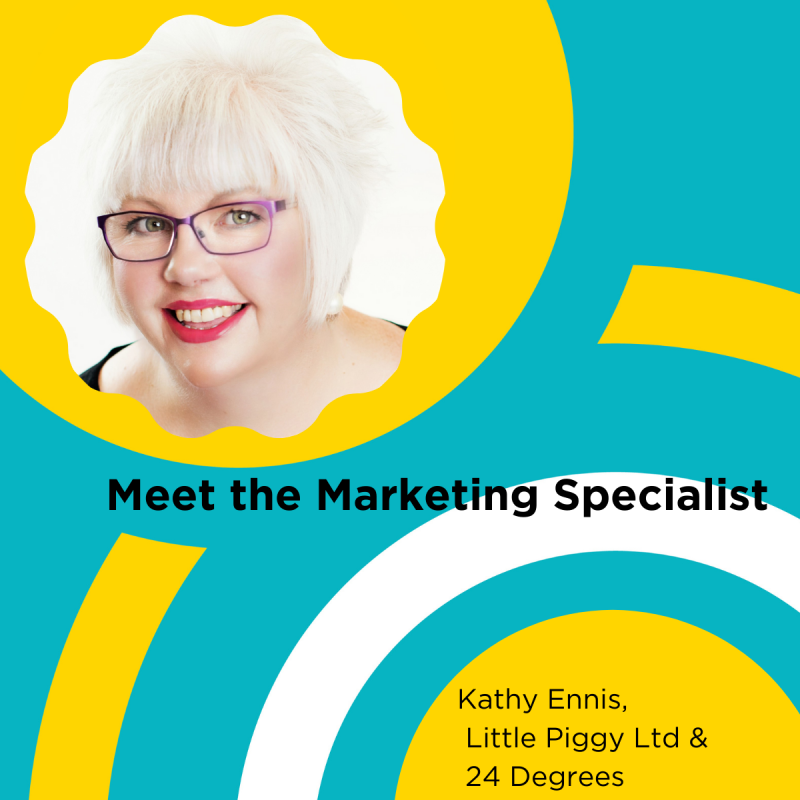
24 Degrees is the brainchild of Kathy Ennis, Founder of Norfolk-based, business mentoring and training company, LittlePiggy and Emma Goode, Founder of the award-winning, Brentwood-based, digital marketing agency, 24 fingers.
Kathy has over 20 years of business experience and is an expert in helping businesses start-up, scale-up and turn their passion for their idea into a profitable business. As a successful Business Mentor and Trainer with 30+ years experience, Kathy has a no-nonsense, you can do it attitude. She specialises in enabling business owners to put the business into their business. Kathy knows that success and failure go hand-in-hand and that planning, processes and systems are the missing link between passion and profit.
With her team of expert content creators at 24 fingers, Emma works with companies who are all fingers and thumbs with their online marketing. She enables them to grow their business and brand through highly effective digital marketing. Whether that’s getting more leads from social, increasing brand awareness or engaging with customers, Emma’s 24 fingers help to add extra digits to a company’s bottom line.
Apparently, the older we get, the less likely we are to make new year’s resolutions. Perhaps it’s because the longer we live, the more we understand how those vague resolutions to lose weight or stop smoking are doomed to fail! But what about making New Year business resolutions?
From a business point of view, making resolutions can be a much more positive experience, giving us an immediate sense of focus as we head into dreary January.
To help get you started, here are six of my favourite new year business resolutions that should help get your mo-jo working in January.
Oh, and by the way, I’ve tested them all myself in the years gone by, and I’m happy to say I’ve kept each one!
1. REALLY Get to Know Your Customer
Relax. I’m not advising you to follow customers home, or stalk them online.
Just take a few moments to think about your ideal customer – in detail.
Where are they likely to live? How old are they? What kind of work do they do? Have they got a family, or a favourite pet?
Understanding who your ideal customer is will help you find the best ways to approach them, so you don’t end up wasting time and that hard-earned marketing budget on content that doesn’t work.
2. Be Where Your Customers Are!
Here’s another question: what social media platforms do your ideal customers use?
For example, there’s no point in you composing snappy tweets, taking umpteen selfies for Insta and creating chatty Facebook posts about your business, if the people most likely to buy from you are on LinkedIn!
Do your research, but don’t forget to check your analytics, too. You’ll need to keep monitoring your social media activity, to make sure it’s reaching the right people at the right time.
3. Help Customers Get to Know You
Being consistent goes a long way to building lasting trust and rapport.
So, make sure all your content speaks with the same voice, in a style and tone your business naturally uses. Your profile pictures also need to be easily recognisable across all platforms.
4. Don’t Rely on Happy Accidents!
Fate is a wonderful ingredient in a romantic film. But if we want the best chance of success in real life, we have to plan.
That means knowing what you want to achieve, then setting goals that allow you to work purposefully towards it.
(If you’re thinking, “why should I plan anything, when 2020 was so unpredictable?” having goals in place means you can simply adjust them to reach your target, rather than going into ‘headless chicken’ mode!)
5. Create Reusable Content
My marketing motto of, “write it once, use it many times” has to go down as one of the biggest time-savers in business!
Examples include re-posting seasonal content, or chopping an old blog post up into bite-sized posts and content for ‘Lives’.
You could also turn your videos into podcasts, or a Facebook post into an engaging infographic (for this, you might find wonder-sites like Canva helpful!)
6. Measure Everything!
As the famous quote goes, “you can’t manage what you don’t measure.”
Measuring the results of your marketing will help you avoid the common business trap of creating content you enjoy, rather than content that attracts and engages customers.
Instead of posting into the dark, regularly checking your website stats and social media analytics will help you focus on what works, so you can ditch what doesn’t.
Meanwhile, if you need some help taking your brilliant ideas from passion to profit, why not book a complimentary, half-hour Breakthrough Session, and get 2021 off to a purposeful start?
As B2B marketing specialists, we thought we’d look at some of the trends in B2B marketing which may influence all businesses in 2020.
Though not every development will be applicable, there are national and global trends in B2B marketing that small and medium business can capitalise upon too in the year ahead.
Marketing Personalisation
Direct marketing has long been one of the most important and effective tactics of B2B marketing. In 2020, the rise of personalised marketing is set to increase.
Today’s consumers expect a lot from the brands they interact with. B2B relationships are becoming no different, as business buyers begin to anticipate the same level of personalisation they receive from B2C brands like Amazon and Netflix.
Increased personalisation means the content of marketing materials is tailored to the individual target organisation and their interests, activity and interactions with your business. The more personalised the method, frequency and message, the greater the results. For example, emails with personalised subject lines are 29.3% more likely to be opened.
‘Hyper-targeting’ may become one of the buzzwords of 2020. It is used to identify the perfect person within a business to target and seeks to understand their values, aspirations, attitudes and selection triggers. Whether sending emails, mailers, social media messages, presentations or proposals, it’s best to find the specific decision maker you need and devise something relatable to refer to in your message.
Account-Based Marketing (ABM)
In 2020, the zenith of personalised B2B marketing may be Account-Based Marketing.
To become more efficient and effective, B2B marketers will expend energy selling to those customers they know would truly benefit from their product or service, rather than speculatively marketing to a broad audience. Online marketing is more targeted, sales pitches are more refined and relationships are more carefully nurtured. Each interaction has a defined purpose and clear objective.
For B2B firms who sell products or services which have a long sales cycle, or involve many stakeholders and decision -makers, Account-Based Marketing represents a more effective way to generate new business.
A 2017 report claimed 87% of B2B marketers said Account-Based Marketing had led to their largest return-on-investment. If you know exactly who you are targeting, your product is high-value and the sales gestation period is long, you should consider Account-Based Marketing.
B2B Influencer Marketing
Influencer marketing has long been a feature of B2C marketing with celebrities, experts and social media stars all affecting buying behaviour.
In 2020, similar tactics may see another incremental increase in B2B marketing though the tactics are different.
Businesses aren’t looking for celebrity testimonials but do appreciate reliable, authoritative and research-backed evidence and opinion of why they should choose a particular product, service or supplier. Customer testimonials and case studies help to influence decision making, as do referrals from current and past clients.
The newest trend is for podcasts where B2B organisations provide entertaining and informative video or audio content which subtly introduces their product and expertise. These are likely to increase in 2020 and can be a powerful tactic for small and medium businesses too.
Longer-Form Content Marketing
Content (in the form of blogs and written articles) has long been an important B2B tactic to grab attention, attract customers and prove your business’s skills and leadership.
For many years, convention has been that content should be short, immediate and to-the-point. 85% of content published on the web contains less than 1000 words. However, articles with more than 1000 words gain much greater engagement and SEO benefits. For 2020, the trend may increasingly be for longer content that is of more value.
Readers who feeling overwhelmed by endless blogs and articles are increasingly finding long-form content better researched, more analytic and more valuable. Google too favours long form content for SEO on the assumption that the information within it is more useful and reliable.
Longer content (over 1,000 words) can put off readers who want quick answers to easy questions. However, these people are generally less likely to be future customers. The remainder tend to have a more genuine interest in your ideas, products or expertise – and are willing to invest their time to gain valuable information.
B2B marketers are moving away from making accessing valuable content (reports and guides etc) subject to completing a sign up or contact form. Gated content deters many, restricts reach and many businesses then fail to use the contact details effectively anyway. People who submit their details often cannot be relied upon to be good leads. As content marketing becomes more important in B2B marketing, the mindset is to distribute content far and wide without restriction.
Video Content
As in 2019, next year is likely to see B2B marketers increasingly turning to interactive visual and video content to better engage their target customers.
A HubSpot survey found 81% of businesses use video content and 74% of business people say they’ve made a purchase after watching another company’s video.
Short-form videos for use on websites and social media are seeing greater use across B2B businesses of all sizes. Other visual content, such as infographics, motion graphics and animations are also becoming more prominent and frequently used to explain products, processes and complex information.
In 2020, this is also likely to lead to greater use of social channels – such as LinkedIn, Facebook and even Instagram – to share video content with other businesses.
Social Selling
In 2020, social selling may become a wider tactic in B2B marketing.
LinkedIn in particular has over a half a billion members, of which 40 million are decision-makers and 61 million are senior level influencers.
Social selling takes advantage of the fact that if you’re active on LinkedIn and other platforms, you’re most likely already connected to individuals who could be your business’s next customers. Social selling simply means prospecting for leads through already built and trusted relationships and LinkedIn is typically the most effective way to do so for B2B.
Employee Advocacy
In 2020, B2B businesses may increasingly encourage – and even incentivise – employees to represent their brand and showcase it to the world.
The most common type of employee advocacy is employees using social media to share and endorse content from their organisation with their own networks.
Only 17% of firms say they currently use such tactics but those who do claim it leads to increased attraction, shorter sales cycles, new revenue streams and more growth.
Experiential Marketing and Immersive Events
Live events such as trade shows and conferences have long been a staple of B2B marketing. Despite of the importance of digital marketing, many B2B marketers consistently rank live events as the strongest tactic for converting leads into new clients.
Live events have evolved hugely in B2C marketing and B2B may follow in 2020. Whether at trade shows, exhibitions, seminars or social events, companies will need to give their audience something memorable that will raise emotions and build relationships.
Tactics and technologies which may become more mainstream in B2B include:
Creative scenic design which moves away from the tradition pop-up stand and table to a more staged trade show presence with lighting, visual displays and comfy furniture
3D projection of images, video or graphics onto walls and surfaces to create a more immersive experience
Interactivity, AR and VR using digital technology to deliver new experiences and information as visitors explore your trade show presence
Website Design and Optimisation
Counter to the recent focus on content market, client experiences and account-based marketing, many B2B firms may once again focus on their website in 2020.
Almost all B2B marketing brings prospective customers to your website. As all modern websites up their game, a B2B website should thus serve as a platform for differentiation, thought-leadership, business development and attracting talented staff – all whilst delivering a great user experience.
In 2020, firms many approach their website redesign or update differently by focusing squarely on their audience and building around the user, not the firm.
SEO will continue to be more critical than ever in competing for online visitors as Google and other search engines become the first port of call for most B2B buyers. The focus of SEO will again include page speed optimisation, mobile-first design and improved security.
Voice-Generated SEO
With the rise of smart speakers and other interactive devices, more people than ever may turn to Alexa, Siri or Cortana for internet searches in 2020.
Google recently released a ‘speak-able schema mark-up’ which allows web designers to nominate sections of their content to respond to voice activated searches. Though still in early development, it’s an area which will play an important role on B2C marketing and trickle down into B2B.
While B2C marketers have been using artificial intelligence (AI) for a while, B2B has been slower to react. With benefits including better insights, detailed analysis, prospect identification, hyper-targeting, content personalisation and automation, it may also become a rising feature of B2B marketing in 2020.
Is 2020 a Pivotal Year for B2B?
Though B2B marketing is always evolving, 2020 may very well become a notable year for a shift towards personalised direct marketing, longer and more valuable content marketing and greater focus on business’s websites as critical to success.
You’re here because you want a successful business, right?
Well, let me start by asking you this. What’s the difference between a successful, profit-making business owner, and one who struggles to pay the bills?
Successful Entrepreneurs Do Their Homework
If you answered that the successful business owner is prepared, you’re right!
The popular myth surrounding top entrepreneurs is that they are talented and intuitive mavericks who fly by the seat of their pants.
But in reality, successful businesspeople prepare. They research their industry, their market, their competition, and their own offer… so when an opportunity arises, they can grab it with both hands.
To the casual observer, these opportunities seem like risks. To the entrepreneur, they are calculated business moves!
The Seven Golden Rules of Business Success
If you want to be a successful business owner, you’ll have to constantly question your assumptions. Not just about your chosen industry and the market you’re operating in, but your own offer.
Each of the Golden Rules below contains a set of essential questions to ask yourself, so you can help lessen uncertainty and risk and do more of what works…
…all of which will, ultimately, help you increase your business profit.
1. It’s All About Outcomes, Not Inputs
You’ve got a great business idea, and you work hard. Surely that’s enough to make a profit?
Factors like these are important, but they won’t generate success on their own. Business success is all about creating outputs for the customer, rather than inputs from you, the business owner.
Turn your focus to the people who are most likely to buy your product or service. Why would they? How, exactly, will it benefit them?
2. Don’t Make Your Business ‘Fit’ a Customer, Decide Who Your Customer Is
‘One size fits all’ isn’t a successful business strategy, so you’ll have to get specific about what works for your target customer (and forget the rest!)
First, ask yourself who they are. Then, why would they buy from you, rather than someone else? What else do they need, and how might you provide it?
Analyse your offer in detail. Are there other customer groups who could benefit from your product or service? Who are they, and where will you find them?
3. Know Your Competition (Then Do It Better!)
Many businesspeople have to steel themselves to look at what their competitors are up to. What if they’re more successful?
But understanding who else is out there, doing what you do, is a golden opportunity for you to do it better!
So, take a deep breath, and get researching. Where are your competitors, and what exactly do they do?
How does your product or service compare… are there any tweaks you could use to make it better, or more unique?
4. Understand Your Market
You may have heard of SWOT and PESTLE before.
If not, they are extremely useful tools you can use to analyse and understand your business market.
SWOT helps you identify Strengths, Weaknesses, Opportunities and Threats for your business, while PESTLE looks at Political, Economic, Social, Technological, Legal, and Environmental impacts in the wider market.
Start by grabbing a piece of paper, and try to list at least two thoughts under each heading.
If you need any help with this, why not book a Breakthrough Session so we can talk about it?
5. Ensure You Are Pricing for Profit, Not How Much You Think They Will Pay
Pricing can be one of the toughest decisions business owners make.
But there are some questions that will help you find the right price points. First: which of your products or services make the most profit? Could you raise the price on those now? Which ones could you increase the prices for over time?
Don’t forget to analyse the purchasing patterns of your ideal customer, so you can feel confident about providing them with the right product or service, at the right price.
6. Make Friends With Your Numbers
Do you know how many customers you need to meet your annual turnover target?
(In my experience, it’s surprising how many business owners don’t!)
If not, get a calculator and start crunching those numbers.
You should also think about how much your business costs to run – things like website maintenance, marketing, and professional memberships all count.
Your financial targets should consider the amount you need to make in order to both cover these costs, and have some money to live on.
7. If It’s Not Working – Ditch It
Now it’s time for some brutal honesty!
Go through your products and services. Are any of them under-performing?
If so, they should be dropped, NOW.
Getting rid of ‘dead wood’ means you can give your time and energy to the products and services that your customers love the most (and the ones that make you the most profit!)
What Next?
Although this is by no means an exhaustive list, following these Golden Rules should help you plan and prepare for business success.
If you need help answering some of the questions, why not book a complimentary, half-hour Breakthrough Session, and we can talk them through together?
There is no question that video is now an important marketing tool and will be for the foreseeable future. But how do you add a video to your email marketing campaigns?
I am sure that you will have noticed that many organisations now turning to video to enhance their news, updates, helpful tips and other information. COVID-19 made ‘Zoom’ and ‘Teams’ names that every business person has recently become aware of, practically overnight. As many of us are working remotely and not able to engage in person it’s easy to see that video can fill an important gap.
Video is now becoming more important as a marketing tool and is likely be for the foreseeable future, but how do you add a video to your Email Marketing Campaigns? There are some important factors to consider as it is vital that you get this right, there is nothing worse than clicking a play button only to discover that it doesn’t work, or worse still, just offers an empty box on the page where your video should be.
Bear in mind that most commonly used email clients including, Outlook, Gmail and Yahoo, do not support video within the body of an email. But that doesn’t mean you can’t have a video within your campaign, it just means that you have to approach it from a different angle to get a video in front of your reader.
Embedding Video in Your Email Campaign
The easiest way to insert a video into your email campaign is to simply create an engaging still from the video and link this to the operational video hosted online. This could be on YouTube, Vimeo or another public video hosting platform. However, a better option would to be to link this to a page on your website where the video is embedded and set to play automatically. This means that when the user clicks on the video not only does it start playing for them automatically, but they are also now on your website where (hopefully) you have other content for them to consume and engage with.
Movement attracts attention
As an alternative to using a still image another technique is to use an animated gif. This is more complex than just using a static image, but the addition of movement into the body of your email can really attract attention
If you have your own design team they should be able to create the necessary gif’s for you. If that’s not the case then you can speak to our design team for this service. In addition there are online tools which can automatically generate gif’s from image sets that you upload. Once you have an animated gif you use it within your campaigns in the same way as a static image.
Placement is important
Make sure you pick the perfect spot within your campaign to place your image or animated gif. If you put it right at the bottom of your campaign and make people scroll (yawn) to get to it they are likely not to see it and therefore not click to watch your video. Ideally you want a short piece of text at the top of your email and then your ‘video’ underneath.
Top Tip – Just push play
Whichever route you take, either inserting an animated gif or a static image, make sure you include a play button on the gif/image to tell the viewer that it is a video and thus encourage them to click through to your content.
If you are struggling to get a video in your campaign or if you would like us to review your campaign before you send it, just drop us a line, we are a friendly bunch and always happy to help! 01603 858250 / communicate@smartmessenger.co.uk
Nothing stands still in the social media world for long, that’s part of the reason we love it so much – there’s rarely a dull moment. But, just when you thought the trend of here-today-gone-tomorrow content was done with, along comes Twitter with its oddly named Fleets.
A squished-up version of ‘fleeting moments’, Fleets last just 24 hours, and are to Twitter what Stories are to LinkedIn and Instagram and, more recently, Vanish mode is to Messenger and Instagram. Or what they all are to Snapchat.
Confused? Let us explain. The boffins at Twitter wanted to give new or shy users the chance to dip a toe in the platform’s conversational waters, without getting bogged down in likes and retweets.
With us so far? Jolly good. Now, this is where Fleets come in. Users can post text, or reactions to tweets with the tweet attached, as well as photos and videos, all of which can be personalised with snazzy backgrounds or fonts.
Here’s where you can go a bit cross-eyed if you don’t pay attention. You can reply to Fleets by sending a private Direct Message, but only if you follow the person you’re contacting and they follow you OR if the person you want to reply to has their Direct Messages set to open.
“We’ve learned that some people feel more comfortable joining conversations on Twitter with this ephemeral format, so what they’re saying lives just for a moment in time,” wrote Joshua Harris, director of design, and Sam Haveson, product manager, in a blog.
We’ll have to wait and see if Fleets bring a host of new blood to the platform, but the feature certainly has got its work cut out for it with the sudden rush of short-term competition. Tell us which are your favourites and we’ll tell you ours…
We’re 24 fingers, a digital marketing agency and a proud member of the Brentwood Chamber of Commerce, Excel Business Networking Group, the Trusted Business Community and the Organisation for Responsible Businesses. If you’re feeling all fingers and thumbs with your online marketing, use our hands (and hearts and minds) to get extra digits on your bottom line. Book your free strategy call here.
Did you know you can also use text marketing for appointment reminders?
Everyone needs an appointment
It used to be that appointments were used only in a few businesses, so people were used to remembering them. As rules change, more and more businesses are finding they now have to use appointments in order to safely manage the risk of coronavirus. Appointments are the perfect way to ensure you’re keeping everyone safe, but there is always a risk of customers forgetting and not turning up. You can’t stop making appointments or overbook and risk too many people turning up at once, so what do you do?
Help stop no-shows
With text reminders, you significantly reduce the risk of no shows by reminding customers about their appointment without the need to make time-sapping reminder phone calls. Unlike other forms of marketing, text messaging has high open rates and fast response times, meaning customers will soon let you know if they can’t make it.
It’s relatively easy to miss or ignore an email and reminder calls are not only time-consuming for you to make, they are unlikely to be made at a convenient time for every customer. Text reminders are the perfect way to get a short message across to customers without intruding on their day.
Not only do text messages cost significantly less than traditional methods, but the reduction in no shows will also mean you’re better off. The best thing to do is to send reminders with enough notice that they can rebook if necessary, without causing too much disruption, but not so much notice that they forget to show up. Most businesses send reminders 24 hours before an appointment, but of course, this part is up to you.
What to include
The main information you should include is the recipient’s name, date and time of their appointment, and where the appointment is being held. If suitable you can also include additional information, such as anything they need to bring, link to a map, photo of the front of your building or other important things they may need to know.
As well as reminding people about their upcoming appointment, it’s good practice to give them an opportunity to rebook. You may be thinking that giving them the ability to change their appointment could cost you but actually, the more intuitive and user-friendly your messages are, the better! Surely, it’s better to have someone rebook than not turn up and disappear forever?
With Smart Messenger Text Messaging you can include links and attachments so that recipients have everything they need in one place.
If you do have a cancellation and a waiting list of people, you may wish to text your waiting list to inform them of the availability.
Mind your tone
How you word your message is key. It should be informative and get to the point but you also want to make sure it’s coming off as friendly and welcoming. Customers should feel as though they can easily call or text you back should they need to and they will be met with a friendly tone. The best advice is to keep the message as short and simple as possible, after all, you’re just reminding them about an appointment, not marketing to them!
Business cost
You might be thinking that text reminders sound like they’ll be a great addition to your business but are wondering if they’re costly to implement. The answer is no, with Smart Messenger we can build a package to suit your needs so whether you’re sending messages to ten or a thousand people we’ll find the right solution for your business. Our prices start from just £10 per month.
If you’d like to find out how text messaging can help reduce your no shows and boost customer satisfaction, get in touch.