The European Commission has published details of its current trade negotiations with Indonesia.
Bilateral trade talks between the EU and the South East Asian country were launched in July 2016, with the aim of concluding a Comprehensive Economic Partnership Agreement (CEPA) between the two.
Issues covered include: customs duties and other barriers to trade; services and investment; access to public procurement markets; competition rules and the protection of intellectual property rights.
When the talks were launched, Trade Commissioner Cecilia Malmström said that an agreement would offer great opportunities for businesses and people in both the EU and Indonesia.
With a population of over 250 million people, Indonesia is the largest market in South East Asia. Figures for 2015 show that bilateral trade in goods between the prospective partners had already reached more than €25 billion that year.
The EU is Indonesia’s fourth largest trading partner, while Indonesia is the Union’s fifth largest partner in the Association of Southeast Asian Nations (ASEAN).
Details of the negotiations just released by the Commission show that the talks have addressed the opening of public procurement markets, the need to reduce unnecessary overlapping regulatory barriers to trade and how to increase trade benefits for small businesses.
They have also considered increased co-operation on the import requirements related to food safety, and to plant and animal health.
In addition to trade issues, the CEPA is also intended to uphold current levels of protection for consumers, workers and the environment, and to promote sustainable development.
Course Aims To provide delegates with the required level of training, skills and knowledge in First Aid, and comply with the requirements of the Health and Safety (First Aid) Regulations 1981.
Suitable For Any person selected by the employer to be a first aider in the work place, who has the aptitude and ability to absorb new knowledge and skills.
Carl Bates is a global entrepreneur, speaker,author, mentor and director. Currently based inSouth Africa, he is a dynamic entrepreneur fromNew Zealand who guides small to medium businessesand privately-held companies to achieve ExtremeBusiness Success.
He is passionate about empowering businessowners to break through the barriers that confinethem to a life of long hours, hard work and littlereward. He challenges his audiences to shift their thinking,increase their vision and take their businessesto the next level.Growing up in a family of entrepreneurshas inspired andenabled Carl to transform theattitudes and practices of business owners aroundthe world. He challenges them to create a businesslegacy they can be proud of and supports them tosee the potential and the possibilities for their ownbusiness. Carl is always focused on ensuring areasof growth are identified and shareholder value ismaximised.
Laws of Extreme Business Success
These are the groundbreaking game rules forsmall to medium enterprises that inspired Carl’sbook ‘The Laws of Extreme Business Success’.With laws that range from treating your businessas an investment and the role of family membersin your own business, to leadership and buildingeffective teams, this presentation inspires businessaudiences across the board to take their businessor organisation’s success to the next level.
This event is aimed at business leaders/owners, start-ups, medium enterprises and those looking to excel in business.Join us for an evening of inspiring talks from Carl Batesand networking!
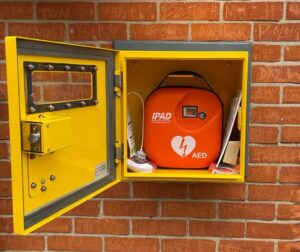
Above: A defibrillator at a rail station. Credit: Greater Anglia
Greater Anglia has installed life-saving heart resuscitators at more of its stations in Cambridgeshire, Essex, Norfolk and Suffolk.
Fifteen Automated External Defibrillators (AEDs) have been installed at Alresford, Braintree, Braintree Freeport, Bury St Edmunds, Cambridge North, Chappel & Wakes Colne, Cheshunt, Diss, Needham Market, Sawbridgeworth, Soham, Stowmarket, Thetford, Waltham Cross and Weeley.
The defibrillators are small, safe and lightweight and deliver a shock to treat someone in cardiac arrest.
They can also monitor the heart’s activity and give instructions to the users.
Anyone can use them. If there is an incident on the station, call 999 to be given a code to open the defibrillator’s storage box and follow the instructions given.
It follows the recent installation of five defibrillators at stations between Hertford East and Broxbourne in Hertfordshire.
Greater Anglia’s Head of Facilities Management, Mark Ellis, said, “Statistics show that 20% of cardiac arrests occur in a public place.
“There is compelling evidence that defibrillation at the earliest possible point after a person collapses can significantly increase their chances of survival, so it’s vital that this life saving equipment is available in public places, particularly somewhere very busy like rail stations.”
“The installation of these defibrillators means that we are better prepared to provide assistance in the event of a first aid emergency.”
Above: A defibrillator at a rail station. Credit: Greater Anglia
Aims to update and requalify existing first aiders to the required level of skill and knowledge in first aid, in accordance with the requirements of the Health and Safety (First Aid) Regulations 1981.
Successful delegates will be awarded a certificate of competence accredited by Qualsafe Awards who are recognised by Ofqual. It is valid for three years.
Course Venue
Open courses are held regularly at our training venues in Norwich, Norfolk and Cambridge, Cambridgeshire. Alternatively, courses can be arranged at your own site anywhere in the UK (subject to suitability).
Syllabus
Introduction to first aid
Incident management and safety
The unconscious patient
Major illness: diabetes, heart attack, stroke
Fractures and dislocations
Head Injuries
Eye Injuries
Simple record keeping & first aid equipment
The legal framework for first and in the workplace
Basic life support
Use of AED
Control of bleeding and shock
Major Illness: epilepsy, allergic reactions
Burns and scolds
Poisons and harmful substances
Basic casualty handling
Knowledge and skills assessments
“2nd course with Norvic and still very good training – excellent”
“Would definitely recommend Norvic Training”
“I have been doing First Aid for 33 years and it was the best course I have been on.”
To provide delegates with the required level of training, skills and knowledge in First Aid, and comply with the requirements of the Health and Safety (First Aid) Regulations 1981.
Suitable For
Any person selected by the employer to be a first aider in the work place, who has the aptitude and ability to absorb new knowledge and skills.
Certification
Successful delegates will be awarded a certificate of competence accredited by Qualsafe Awards who are recognised by Ofqual. It is valid for three years.
Syllabus
Introduction to first aid Incident management and safety The unconscious patient Major illness: diabetes, heart attack, stroke Fractures and dislocations Head Injuries Eye Injuries Simple record keeping & first aid equipment The legal framework for first and in the workplace Basic life support Control of bleeding and shock Major Illness: epilepsy, allergic reactions Burns and scolds Poisons and harmful substances Basic casualty handling Knowledge and skills assessments
“Good course with refreshing content. Great value for money.”
The Ministry of Supply in Egypt is planning to import some food products and is seeking quotations from British companies who could export such products to Egypt.
The request includes the following items :
Broad Beans ( dried beans -Fava beans-shipped in sacks) : amount of 490, 000 tonnes per annum
Lentils : amount of 300,000 tonnes per annum
Frozen Halal Meat : amount of 48,000 tonnes per annum
Frozen Halal Poultry : amount of 60,000 tonnes per annum
If you are interested in providing a quotation for this amazing opportunity, please email us and we will pass your details on.
As the Chamber Network gathers in Westminster for the BCC Annual Conference, the British Chambers of Commerce has today (Tuesday) published a business blueprint for the UK government ahead of the upcoming Brexit negotiations.
Titled Business Brexit Priorities, the report synthesizes feedback from over 400 businesses at 16 Chamber-hosted focus groups, along with nearly 20,000 responses to Chamber surveys. It puts forward priorities for action across seven key areas where business communities want practical solutions and certainty.
BCC evidence confirms that Europe will remain a key market for UK exporters and importers well into the future. As a consequence, it is imperative that the government achieves a pragmatic UK-EU deal that facilitates continued trade.
The key recommendations in the report are:
On the Labour Market, the government should provide certainty for businesses on the residence rights of their existing EU workers, provide clarity on hiring from EU countries during the negotiation period, and avoid expensive and bureaucratic processes for post-Brexit hires from the EU
On Trade, the government should aim to minimise tariffs, seek to avoid costly non-tariff barriers, grandfather existing EU free trade agreements with third countries, and expand the trade mission programme
On Customs, the government should develop future customs procedures at the UK border in partnership with business, seek to maintain the UK’s position as an entry point for global businesses to Europe
On Tax, the government should guarantee that HMRC is appropriately resourced to help businesses through the transition process, and provide clarity on whether VAT legislation will continue to mirror current core VAT principles
On Regulation, the government should ensure stability by incorporating existing EU regulations into UK law and maintaining these for a minimum period following Brexit, and ensure that product standards are aligned with, and recognised by, the EU to keep UK products competitive
On EU funding, the government should maintain UK access to the European Investment Bank, and ensure there is no funding ‘cliff-edge’ for areas in receipt of EU funding
On Northern Ireland, the government must avoid any return to a hard border, so that businesses can move people and goods as freely as possible.
Commenting on the report, Julie Austin, International Trade Manager for Norfolk Chamber, said:
“Business communities across Norfolk and the UK want practical considerations, not ideology or politics, at the heart of the government’s approach to Brexit negotiations.
“What’s debated in Westminster often isn’t what matters for most businesses. Most firms care little about the exact process for triggering Article 50, but they care a lot about an unexpected VAT hit to their cash flow, sudden changes to regulation, the inability to recruit the right people for the job, or if their products are stopped by customs authorities at the border. The everyday nitty-gritty of doing business across borders must be front and centre in the negotiation process.”
Also commenting on the report, Adam Marshall, BCC Director General, said:
“What’s also clear is that the eventual Brexit deal is far from the only thing on the minds of the UK’s business communities. An ambitious domestic agenda for business and the economy is also essential so that business can drive our post-Brexit success. Firms across the UK want a clear assurance that Brexit isn’t going to be the only thing on the government’s economic agenda for the next few years.”
Marcus Mason, Head of Business at the BCC, and author of the report, added:
“Since the historic vote on June 23, we have worked with Chamber business communities all across the UK to determine their key priorities for the Brexit transition.
“This report brings those practical priorities together and urges the government to adopt them in the forthcoming negotiations. Chambers of Commerce stand ready to help the government shape a pragmatic and practical approach to the coming transition, so that firms can continue to trade successfully with customers and suppliers across Europe and around the world.”
“16 years in care – best manual handling I’ve had! Very informative and relaxed” “I’ve learnt more your training course then I ever have on any previous patient handling course”
Course Aims Training is based on The Handling of People 6th Edition.
To meet the statutory needs of the Manual Handling Operations Regulations 1992. To provide sufficient knowledge and training for the delegate to carry out manual handling tasks safely, confidently and avoid injury to both him/herself and others. The course will also include a suitable risk assessment format. We also offer a site visit to your place of work to carry out a risk assessment on the ground should you require it.
Suitable For For staff members who move patients as part of their duties.
Temporary traffic lights will be in use on the A140 Cromer Road north of the B1149 Holt Road roundabout for up to one week from Monday 27 February to allow National Grid to continue gas main diversions that will enable construction of the major junction between the A140 and Norwich Northern Distributor Road.
Where possible, the lights will be suspended during peak hours. If this is not possible, they will be manually controlled to minimise the impact on traffic. Norfolk County Council apologises for any inconvenience.
On 14th September 2023 we attended the National Paralegal Awards 2023. We are delighted that Serena Ely and Julie Garrod both came home with awards! Serena won Best Will Writing Paralegal and Julie came highly commended in Best Conveyancing Paralegal. Congratulations!
The National Paralegal Awards 2023 focused on the achievements of paralegals in the UK. Whether they are employed, self-employed, a volunteer or a business, as well as companies that support the profession. The National Paralegal Awards is an exciting opportunity for the legal sector to reward and recognise the outstanding paralegal talent in the UK. Entered by some of the best, these awards are a chance for paralegals to show what they have achieved and to be celebrated amongst their peers.
Nigel Craske, Senior Partner, and Amy Church, Managing Partner, joined Serena and Julie for an evening of food, entertainment and celebration at The Grand Hotel in Birmingham. The food was fantastic! Between the main course and dessert, they were entertained by Big Muma Funk, before the awards ceremony kicked off.
When announcing Serena as the winner of Will Writing Paralegal, the judges said:
“An interesting journey. This nominee demonstrates grit, determination and compassion. An admiral and human approach to the legal profession. Her achievements have contributed to her firms success and reputation and their innovative approach is of note. A very strong submission.”
Amy Church, Managing Partner, comments “I am over the moon for Julie and Serena. Their recognition at the National Paralegal Awards reflects their hard work and commitment to the profession and their clients. Both Julie and Serena strive to provide a high level of service and I am delighted that their hard work has been recognised.”
An influential Parliamentary Committee has launched an inquiry into support for exports and investment, building on an investigation last year into “Exports and the role of UKTI”.
Chairman of the International Trade Committee, Angus MacNeil, explained: “Before the Department for International Trade (DIT) was created, our colleagues on what was then the Business, Innovation and Skills (BIS) Committee did some excellent work scrutinising the role of UK Trade and Investment (UKTI).”
As UKTI has now been absorbed into the DIT, he went on, the Committee wants to find out how these new arrangements have affected its performance given that evidence was found of significant flaws in UKTI’s previous operating model.
Interested organisations or individuals are being invited to submit written evidence to the Committee by 5pm on 8 March 2017.
In particular, it will examine whether International Trade and Investment (ITI, formerly UKTI) and UK Export Finance (UKEF) have improved on their performance since the BIS Committee inquiry in 2016.
In the light of the Secretary of State’s admission that the £1 trillion export target will not be met, the Committee also wants to know if the Department’s export and investment targets are transparent, appropriate and achievable.
Evidence can be submitted through the inquiry page at www.parliament.uk.
“This is a time of great uncertainty for UK exporters of all sizes,” Mr MacNeil concluded. “It is vital that they get the right support.”