CHIEF will be switched off on 31st March 2023 Our message is: do not delay, make a plan for CDSAs many of us are aware, import declarations will soon be migrated to CDS.
The Government have started the countdown to CHIEF’s shutdown, setting 30 September 2022 as the date for CDS to handle all import declarations, and the last date for export declarations in CHIEF will be 30 March 2023.
To avoid delays and issues at the border, your preparation for this change will be as important as those made for Brexit.
Last week’s announcement
“HMRC will be closing its Customs Handling of Import and Export Freight (CHIEF) system on 31 March 2023. From this date, all businesses will need to declare goods through the Customs Declaration Service (CDS). . .
CDS has been developed over a number of years in consultation with the border industry and will provide a more secure and stable platform that has the capacity and capability to grow in line with the government’s ambitious trade plans.
The move to one system for all imports and exports will also deliver savings for the taxpayer”.
3. If you use an Agent to submit your declarations you should check what their plans are to get CDS ready. You will need to give them the relevant access to CDS and agree a revised instruction and checking process
4. If you submit declarations using a third party software provider then make sure that you engage with them so that you can update your systems
5. You might like to try the Trader Dress Rehearsal Service, with the assistance of your software provider. This lets you test your readiness and submit different declaration scenarios in a simulated Customs Declaration Service.
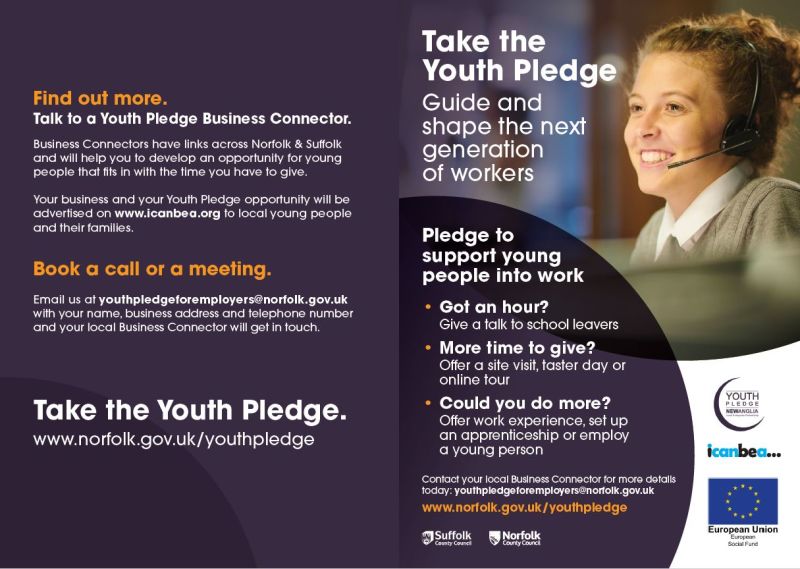
Business Connectors have links across Norfolk & Suffolk and will help you to develop an opportunity for young people and will help you to develop an opportunity for young people that fits in with have the time you have to give.
Your business and your Youth Pledge opportunity will be advertised on www.icanbea.org to local young people and their families.
Book a call for a meeting.
Email us at youthpledgeforemployers@norfolk.gov.uk with your name, business address and telephone number and your local Business Connector will get in touch.
Council is delighted to work alongside Andrea in setting up her own community micro-enterprise providing care and support for people in her local area.
Andrea is an experienced carer and was in the process of setting up her own business. The Community Catalysts programme was able to work with Andrea through the process of ensuring that she had everything required to run her small care and support enterprise. Claire had already obtained a DBS and registered with HMRC. With the Community Catalysts programme, she was able to work at her own pace and get advice and guidance about insurance, regulations around sole traders offering care, safeguarding, risk assessment and other essentials. Through the programme she has also been able to connect, informally to other self-employed people for mutual support and networking.
Andrea now has her own business up and running and she has taken on her very first customers. She is looking forward to delivering care and support her way and running her quality small business with pride.
If you would like to learn more about running your own small enterprise that offers a range of help and support to older and disabled people in their homes, please do contact me, Debra on
Get More Customers With These Ten Fool-Proof Strategies
Kathy Ennis, LittlePiggy
As a micro business Mentor, I speak to plenty of new business owners who are ultra-confident about their product or service (which is great!) But when I ask how they’re going to get more customers, they look confused.
They’ve been working long and hard on perfecting their offer… isn’t that enough?
High quality products or services are important, of course. But without enough people who want to buy them, your business won’t be successful.
So, here are ten fool-proof strategies to help you get more customers.
1. Don’t Forget Your Existing Customers
When you plan for business growth the temptation can be to concentrate on the search to get more customers. But what about the ones you already have?
Don’t get so fixated on attracting new customers, that you leave the ‘old’ ones behind.
Especially when someone who has bought from you before is likely to buy again.
Not only that, but getting the customers you already have to buy something else costs about seven times less than attracting new customers.
Why?
Because your current customers already know you and love you!
2. Be Your Own PR Expert
You don’t have to become a character from Absolutely Fabulous to be good at PR.
All you’ve got to do is let more people know how amazing you are!
To do this, make sure you’re blogging regularly. Each blog post should demonstrate your knowledge, expertise, and personality, so people finish them feeling compelled to get in touch.
Meanwhile, journalists are always looking for knowledgeable people to comment for news articles, so why not be one of them? Type #journorequest into Twitter, and see who’s on the search.
Don’t forget about your local paper, too. If you’ve got an interesting story to share, why not put a short press release together?
3. Use Social Media (But Differently)
That famous old saying, “if you do what you’ve always done, you’ll get what you’ve always got” can be easily applied to social media!
Don’t keep pitching the same old messages, and make sure you adapt your tone to suit the platform you’re using.
(You shouldn’t use the same style for a tweet as you would a Facebook post, for example.)
But for the best customer-attracting results, don’t just write random posts every now and again.
Try scheduling specific campaigns (such as a seasonal offer) and plan specific, targeted social media activity that supports them.
4. Get Your Face and Voice Out There!
OK, this might involve stepping out of your comfort zone.
But recording a podcast or a video (or a Live video if you’re feeling brave!) will not only demonstrate your expertise, they will also help people get to know you.
And if they know you, they’ll feel more comfortable buying from you.
A downloadable lead magnet (think ‘Five Top Tips’ or ‘How To…’) will help attract potential customers to your website, and sign up to your mailing list.
If you can’t afford a designer to make your lead magnet look pretty, try experimenting yourself, with free, easy-to-use sites like Canva.
6. Host an Event
Shine a spotlight on your expertise, by hosting a customer-attracting event.
This could be a webinar, a networking meeting, or even a conference – whatever takes your fancy the most.
(Don’t forget to plan a social media campaign to promote your event!)
7. Collaborate with a Talented Partner
Two heads are better than one, so try teaming up with another businessperson, whose skills complement yours.
Is there a specific project you could launch together… something that would attract new customers to both of your businesses?
Don’t put pressure on yourselves, as this doesn’t have to be a formalised ‘company’. Just find someone you can have fun and share ideas with, and you never know where it might lead!
I’ve worked on lots of creative and exciting projects with my main collaborator, the amazing Emma Goode of 24fingers, including our regular co-hosted training events.
8. Let People Know You Care
You don’t have to do all the heavy promotional lifting yourself, you know!
Share reviews, testimonials, and longer case studies that show potential new customers just how much your current ones love you.
Drill into as much detail as possible about the problems you helped them solve, and how happy they were with the results.
9. Invest in Advertising
As we covered in Strategy 3, it’s not enough to broadcast random messages here and there.
You have to get campaigning, and that involves being specific.
So, do some research and testing to help you discover what type of ad campaign will work best for your ideal customer group.
This could involve social media platforms like Facebook or Instagram, web campaigns like Google Pay-Per-Click, or even old-fashioned leafleting.
(Yes, advertising costs money. But once you hit on a method that works, it’ll pay dividends!)
10. Be Planned and Be Consistent
Don’t get me wrong. I’m all for spontaneity… sometimes!
But when it comes to business, planning is best, because it helps you focus on what you need to achieve.
For example, saying “I want to get more customers” isn’t helpful unless you also understand, a) how many more customers you need, and b) how you’re going to get them.
So, create a plan, then follow it.
Measure your progress along the way – the great thing about having a plan is that you can check how well it’s going – and make adjustments as needed.
If something’s working particularly well, keep doing it… and if something’s not working at all, stop!
It really is as simple as that.
I hope you’ve found something useful to work on here.
Need some extra help? Remember, my own expertise involves helping micro business owners and side-hustlers like you do all of the above!
So, why not download one of my powerful toolkits, or contact me for a half-hour, no obligation Breakthrough Session?
As a micro business Mentor, I speak to plenty of new business owners who are ultra-confident about their product or service (which is great!) But when I ask how they’re going to get more customers, they look confused.
They’ve been working long and hard on perfecting their offer… isn’t that enough?
High quality products or services are important, of course. But without enough people who want to buy them, your business won’t be successful.
So, here are ten fool-proof strategies to help you get more customers.
1. Don’t Forget Your Existing Customers
When you plan for business growth the temptation can be to concentrate on the search to get more customers. But what about the ones you already have?
Don’t get so fixated on attracting new customers, that you leave the ‘old’ ones behind.
Especially when someone who has bought from you before is likely to buy again.
Not only that, but getting the customers you already have to buy something else costs about seven times less than attracting new customers.
Why?
Because your current customers already know you and love you!
2. Be Your Own PR Expert
You don’t have to become a character from Absolutely Fabulous to be good at PR.
All you’ve got to do is let more people know how amazing you are!
To do this, make sure you’re blogging regularly. Each blog post should demonstrate your knowledge, expertise, and personality, so people finish them feeling compelled to get in touch.
Meanwhile, journalists are always looking for knowledgeable people to comment for news articles, so why not be one of them? Type #journorequest into Twitter, and see who’s on the search.
Don’t forget about your local paper, too. If you’ve got an interesting story to share, why not put a short press release together?
3. Use Social Media (But Differently)
That famous old saying, “if you do what you’ve always done, you’ll get what you’ve always got” can be easily applied to social media!
Don’t keep pitching the same old messages, and make sure you adapt your tone to suit the platform you’re using.
(You shouldn’t use the same style for a tweet as you would a Facebook post, for example.)
But for the best customer-attracting results, don’t just write random posts every now and again.
Try scheduling specific campaigns (such as a seasonal offer) and plan specific, targeted social media activity that supports them.
4. Get Your Face and Voice Out There!
OK, this might involve stepping out of your comfort zone.
But recording a podcast or a video (or a Live video if you’re feeling brave!) will not only demonstrate your expertise, they will also help people get to know you.
And if they know you, they’ll feel more comfortable buying from you.
A downloadable lead magnet (think ‘Five Top Tips’ or ‘How To…’) will help attract potential customers to your website, and sign up to your mailing list.
If you can’t afford a designer to make your lead magnet look pretty, try experimenting yourself, with free, easy-to-use sites like Canva.
6. Host an Event
Shine a spotlight on your expertise, by hosting a customer-attracting event.
This could be a webinar, a networking meeting, or even a conference – whatever takes your fancy the most.
(Don’t forget to plan a social media campaign to promote your event!)
7. Collaborate with a Talented Partner
Two heads are better than one, so try teaming up with another businessperson, whose skills complement yours.
Is there a specific project you could launch together… something that would attract new customers to both of your businesses?
Don’t put pressure on yourselves, as this doesn’t have to be a formalised ‘company’. Just find someone you can have fun and share ideas with, and you never know where it might lead!
I’ve worked on lots of creative and exciting projects with my main collaborator, the amazing Emma Goode of 24fingers, including our regular co-hosted training events.
8. Let People Know You Care
You don’t have to do all the heavy promotional lifting yourself, you know!
Share reviews, testimonials, and longer case studies that show potential new customers just how much your current ones love you.
Drill into as much detail as possible about the problems you helped them solve, and how happy they were with the results.
9. Invest in Advertising
As we covered in Strategy 3, it’s not enough to broadcast random messages here and there.
You have to get campaigning, and that involves being specific.
So, do some research and testing to help you discover what type of ad campaign will work best for your ideal customer group.
This could involve social media platforms like Facebook or Instagram, web campaigns like Google Pay-Per-Click, or even old-fashioned leafleting.
(Yes, advertising costs money. But once you hit on a method that works, it’ll pay dividends!)
10. Be Planned and Be Consistent
Don’t get me wrong. I’m all for spontaneity… sometimes!
But when it comes to business, planning is best, because it helps you focus on what you need to achieve.
For example, saying “I want to get more customers” isn’t helpful unless you also understand, a) how many more customers you need, and b) how you’re going to get them.
So, create a plan, then follow it.
Measure your progress along the way – the great thing about having a plan is that you can check how well it’s going – and make adjustments as needed.
If something’s working particularly well, keep doing it… and if something’s not working at all, stop!
It really is as simple as that.
I hope you’ve found something useful to work on here.
Need some extra help? Remember, my own expertise involves helping micro business owners and side-hustlers like you do all of the above!
So, why not download one of my powerful toolkits, or contact me for a half-hour, no obligation Breakthrough Session?
UK small and medium-sized businesses are owed an estimated £32.4 billion in late payments from debtors, according to a report by Bacs Payment Schemes (Bacs).
Cash is the lifeblood of your business, and there is little profit to be made from empty promises of payment. Of course, there’s an inevitable element of risk in sales – you can’t confine yourself to just ‘safe’ customers – but you can go a long way to limiting the risk.
Thoroughly research the background of the customer. This could be as simple as speaking to other people who’ve dealt with them.
Ask for cash in advance or on delivery (although this might not be practical with larger companies with strict payment procedures).
Send the customer your terms and conditions, and ask for approval – before you start working with them.
Get to know how each customer’s payment system works. This can be especially important with big companies, who might have very formal procedures in place and could refuse to pay without a purchase order.
Introduce yourself to the person who’s responsible for drawing cheques and making payments.
Offer prompt or early payment discounts. But be careful how much you give – you don’t want to eat into your profit margins.
We can offer you an outsourced credit control service, helping you maximise cash flow, reduce your need for bank borrowing, reduce bad debts, and concentrate on running your business.
The growth and development of technology in business during the last decade has completely transformed business. In a relatively short period it has revolutionised every business activity in almost every sector, industry and market, resulting in greater efficiency and cost savings.
This transformation and reliance on digital systems has however placed a huge reliance on the integrity of the technology, the internet and the systems in place to secure businesses’ online assets. It is this integrity, or rather the lack of it, which is fuelling an exponential rise in cyber attacks on businesses which may not only affect performance but can lead to total business collapse.
No company too small
Attacks are not limited to large businesses however. No company is too small to be the victim of a cyber attack. Hackers don’t just want to steal money from the company they are targeting, they may be looking to step onto a larger company and 80% of hacks at larger companies start in the supply chain.
These suppliers provide an easy route into the larger companies because the defences between the main company and its supplier will also be weaker than the external protection of the larger company.
Spoofed internal emails
One of the most common and simple attacks involve bogus invoices or requests for payment. Huge damage can be created with a stolen or ‘spoofed’ email address. For example, the financial department receive a ‘spoofed’ email supposedly from a senior board member asking for a cheque to be paid into a certain account.
The financial department doesn’t query the request as it appears to be from a senior executive and the cash is transferred, never to be seen again. A recent IoD report claims that 72% of businesses have been the victim of bogus invoices.
The perception that the majority of cyber attacks emanate from Eastern Europe or China is far from true. Insiders are responsible for as many as 60% of all data breaches courtesy of either good old human error or deliberate action.
Measures to protect your business
In addition to awareness of the threat and internal vigilance what can you do now to protect yourself further? Proactive management, education and a company-wide security culture will go far in countering the threat, while at the same time ensuring more trained eyes to help counter potential attacks and enhance overall business resilience. Specific measures you should consider include:
1. Having a cyber insurance policy: This makes good sense, but it is by no means a silver bullet and may not cover all outcomes such as reputational damage.
2. Contingency planning: Boards should plan how they would react to different scenarios and have a mitigation plan for when their business is hacked or compromised. It is important that all departments are involved in this; cyber security is as much an HR issue as an IT one.
3. Awareness: Senior managers should ensure all employees are cyber aware and alert to scams and social engineering, including not sharing passwords or memory sticks and are aware of public Wi-Fi risks.
4. Supplier Integrity: Cloud and IT providers must demonstrate the integrity of the security protocols they have in place and their disaster recovery plans.
5. Audits: Conduct a data audit to classify your most sensitive data.
6. Antivirus: Always have up-to-date antivirus software and check that all mobile phones and tablets have antivirus software installed.
Technology and the internet have delivered huge benefits, providing huge potential for businesses to flourish and opportunities for new forms of on-line enterprise to enhance our lives. But with the benefits come the risk to the security of on-line resources and assets.
Regulation is on the way to ensure business leaders are taking steps to ensure their on-line resources and assets are properly protected, with sanctions against those who don’t comply. But the largest sanction of all is your business being targeted and disappearing overnight.
One thing that you cannot deny throughout the COVID-19 pandemic is the Government’s sustained efforts to try and support businesses and scaffold the economy in a time of significant uncertainty. As the country moves toward a normality that resembles life pre-pandemic, many businesses are asking what support is available for those still feeling the impact and for those who are wishing to maximise on opportunities available to them.
In March, the Government announced the closure of the Bounce Back and Coronavirus Business Interruption Loan schemes; and introduced the Recovery Loan Scheme to provide continued financial support to businesses across the UK as they trade out of the pandemic.
The scheme is open to any business that has been affected by COVID-19, and the use of funding is unlimited, provided it is for a legitimate business purpose. Businesses can borrow up to £10m per business (or up to £30m for groups). Businesses will also be happy to hear that you can still access this scheme, even if you have accessed other Government support schemes such as the Bounce Back scheme, CBILS or CLBILS. However, the amount available to borrow under the RLS will be reduced by any borrowing from previous schemes.
The scheme provides guarantees to lenders via several different facility types:
Term loan
Overdraft
Invoice finance
Asset finance
It is important to note that not all lenders are accredited to offer all types of facility.
Businesses seeking to apply for the scheme should ensure they have sufficient debt capacity to take on any additional funding of this kind. In addition, we strongly advise that you (with support from your advisors, if required) take the time to appropriately plan and produce a robust cash flow forecast to ensure that:
there is a legitimate requirement for the funding
you know to what level funding support is required
that the business is in a position to service the debt
This is relevant for any business considering the scheme, but particularly to those businesses that have already accessed other Government support schemes (or other commercial debt facilities) and are yet to understand the true amount of their repayment commitment fully; and/or whose turnover/working capital continues to be impacted by the pandemic and is variable upon the success of the easing of social distancing restrictions. This is also particularly relevant as, as with other external finance applications, you will need to be able to provide a solid business case for the funding, proving you will be able to meet the repayment obligations.
So how does RLS work?
The RLS will be available through named lenders accredited by the British Business Bank. Further accredited lenders may be added as the scheme continues, and you can view the current list on the BBB’s website. However, lenders are advising that you speak with your existing finance provider first before approaching these lenders, as they may be able to offer you a commercial loan on better terms.
Key features of the scheme:
The scheme will remain open until at least 31 December 2021, subject to review.
There is also no maximum cap set for the amount available to lend to businesses through the scheme – so there is no need to rush to apply if you do not feel you require financial support in the immediate term.
There is no minimum or maximum turnover restriction for businesses seeking to access the scheme.
The upper limit of the facility provided to each business is £10m (and up to £30m across a group), with minimum facilities starting at £1,000 for asset and invoice finance, and £25,001 for term loans and overdrafts. (Please note – individual lenders will set their own minimum and maximum limits within these ranges).
The scheme gives the lender a government-backed guarantee against the outstanding balance of the facility.
The annual rate of interest, upfront fee and other fees cannot exceed 14.99%, and businesses are required to meet all costs, interest payments and fees associated with the facility.
Term lengths:
Term loans and asset finance = 3 months – 6 years
Overdrafts and invoice finance = 3 months – 3 years
If you borrow £250,000 or less, personal guarantees will not be taken by the lender. For borrowings over £250,000, personal guarantees are at the lender’s discretion. Still, the maximum that can be covered is 20% of the outstanding balance of the RLS facilities after the proceeds of business assets have been applied.
Lenders can offer an RLS facility to those businesses that would either not gain the funding on standard terms or would do but at a higher rate without the benefit of the government-backed guarantee.
In contrast to other Government support schemes, the RLS will not include 12-month Business Interruption Payments (BIP) to cover interest payments.
Our advice to those looking to access the scheme:
While this next stage of Government support for businesses is being welcomed, business owners should remember that it is still a loan that needs to be repaid. Its purpose is to support with working capital requirements or to support growth. Lenders will be looking for you to be confident in and provide suitable evidence to support that the funding will be used to help the business grow, further benefiting the economy with jobs and supply chain benefits.
It is also worth remembering that there is no cap on the funding available to all businesses. The scheme remains open to applications until 31 December 2021; therefore, there is no immediate need or panic to apply for funding. Instead, it is better to take this time to develop your business’ recovery plan properly, revisit your strategy, and put together a robust set of financials to identify what, if any, funding requirements you have. This may start with improving working capital efficiencies, cutting further none essential spending and equity or other debt funding options (aside from RLS). This will mean that not only will you potentially avoid taking on further debt unnecessarily, but also, if applying for RLS is the right thing for your business’ recovery, you will be adequately prepared for lenders’ due diligence.
We always recommend that you seek advice from a suitably qualified adviser before taking any action. The information in this article only serves as a guide, and no responsibility for loss occasioned by any person acting or refraining from action as a result of this material can be accepted by the authors or the firm.
You can view this original Price Bailey article here
Subscribe
For more insight, events and webinars, sign up to the Price Bailey mailing list…
One thing that you cannot deny throughout the COVID-19 pandemic is the Government’s sustained efforts to try and support businesses and scaffold the economy in a time of significant uncertainty. As the country moves toward a normality that resembles life pre-pandemic, many businesses are asking what support is available for those still feeling the impact and for those who are wishing to maximise on opportunities available to them.
In March, the Government announced the closure of the Bounce Back and Coronavirus Business Interruption Loan schemes; and introduced the Recovery Loan Scheme to provide continued financial support to businesses across the UK as they trade out of the pandemic.
The scheme is open to any business that has been affected by COVID-19, and the use of funding is unlimited, provided it is for a legitimate business purpose. Businesses can borrow up to £10m per business (or up to £30m for groups). Businesses will also be happy to hear that you can still access this scheme, even if you have accessed other Government support schemes such as the Bounce Back scheme, CBILS or CLBILS. However, the amount available to borrow under the RLS will be reduced by any borrowing from previous schemes.
The scheme provides guarantees to lenders via several different facility types:
Term loan
Overdraft
Invoice finance
Asset finance
It is important to note that not all lenders are accredited to offer all types of facility.
Businesses seeking to apply for the scheme should ensure they have sufficient debt capacity to take on any additional funding of this kind. In addition, we strongly advise that you (with support from your advisors, if required) take the time to appropriately plan and produce a robust cash flow forecast to ensure that:
there is a legitimate requirement for the funding
you know to what level funding support is required
that the business is in a position to service the debt
This is relevant for any business considering the scheme, but particularly to those businesses that have already accessed other Government support schemes (or other commercial debt facilities) and are yet to understand the true amount of their repayment commitment fully; and/or whose turnover/working capital continues to be impacted by the pandemic and is variable upon the success of the easing of social distancing restrictions. This is also particularly relevant as, as with other external finance applications, you will need to be able to provide a solid business case for the funding, proving you will be able to meet the repayment obligations.
So how does RLS work?
The RLS will be available through named lenders accredited by the British Business Bank. Further accredited lenders may be added as the scheme continues, and you can view the current list on the BBB’s website. However, lenders are advising that you speak with your existing finance provider first before approaching these lenders, as they may be able to offer you a commercial loan on better terms.
Key features of the scheme:
The scheme will remain open until at least 31 December 2021, subject to review.
There is also no maximum cap set for the amount available to lend to businesses through the scheme – so there is no need to rush to apply if you do not feel you require financial support in the immediate term.
There is no minimum or maximum turnover restriction for businesses seeking to access the scheme.
The upper limit of the facility provided to each business is £10m (and up to £30m across a group), with minimum facilities starting at £1,000 for asset and invoice finance, and £25,001 for term loans and overdrafts. (Please note – individual lenders will set their own minimum and maximum limits within these ranges).
The scheme gives the lender a government-backed guarantee against the outstanding balance of the facility.
The annual rate of interest, upfront fee and other fees cannot exceed 14.99%, and businesses are required to meet all costs, interest payments and fees associated with the facility.
Term lengths:
Term loans and asset finance = 3 months – 6 years
Overdrafts and invoice finance = 3 months – 3 years
If you borrow £250,000 or less, personal guarantees will not be taken by the lender. For borrowings over £250,000, personal guarantees are at the lender’s discretion. Still, the maximum that can be covered is 20% of the outstanding balance of the RLS facilities after the proceeds of business assets have been applied.
Lenders can offer an RLS facility to those businesses that would either not gain the funding on standard terms or would do but at a higher rate without the benefit of the government-backed guarantee.
In contrast to other Government support schemes, the RLS will not include 12-month Business Interruption Payments (BIP) to cover interest payments.
Our advice to those looking to access the scheme:
While this next stage of Government support for businesses is being welcomed, business owners should remember that it is still a loan that needs to be repaid. Its purpose is to support with working capital requirements or to support growth. Lenders will be looking for you to be confident in and provide suitable evidence to support that the funding will be used to help the business grow, further benefiting the economy with jobs and supply chain benefits.
It is also worth remembering that there is no cap on the funding available to all businesses. The scheme remains open to applications until 31 December 2021; therefore, there is no immediate need or panic to apply for funding. Instead, it is better to take this time to develop your business’ recovery plan properly, revisit your strategy, and put together a robust set of financials to identify what, if any, funding requirements you have. This may start with improving working capital efficiencies, cutting further none essential spending and equity or other debt funding options (aside from RLS). This will mean that not only will you potentially avoid taking on further debt unnecessarily, but also, if applying for RLS is the right thing for your business’ recovery, you will be adequately prepared for lenders’ due diligence.
We always recommend that you seek advice from a suitably qualified adviser before taking any action. The information in this article only serves as a guide, and no responsibility for loss occasioned by any person acting or refraining from action as a result of this material can be accepted by the authors or the firm.
In the words of the Blues Brothers, “We’re getting the band back together again”. Well, maybe not the band but do you want to get your team back together again?
After more than a year of staff working from home, others being furloughed, and those who have remained in the workplace, we are all missing the social interaction between colleagues. Making time for non-work activities and making sure everyone takes a break during the day is vitally important for the health and wellbeing of your staff.
Hands On At Work specialises in workplace massage and wellbeing services. Just turning up at your door with our massage chair creates a buzz about the place and lifts the atmosphere as the anticipation rises of a good pummelling to free those tight back, neck and shoulders.
Or feel the energising force of laughter with one of our Laughter Yoga sessions, harnessing that feel-good factor.
Or calm everything down with our peaceful videos of nature and affirmations, the gentle moves of Qiki Gong, or the benefits of a good stretch with our Desk Yoga.
Companies who put health and wellbeing at the centre of their business create productive, engaged, and motivated teams which in turn provide excellent customer service and which ultimately reflect upon you as a great employer to work for.
Call us now to find out how Hands On At Work can help you create a wellbeing strategy with long term benefits.
We know many business owners wear several hats, from HR to PR and back again and there are some days that really ought to be four times as long, so everything gets done. Fear not, under-pressure damsels in business distress. Like a knight in slimline silver armour, Linkedin’s new features are coming to your rescue and promise will make life a bit easier.
We’re big believers in every little helping, so let’s take a closer look at the goodies (Ed’s note: don’t you mean the Goode stuff? #badumtush)
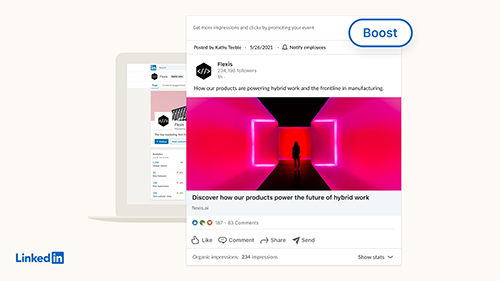
Supercharge your posts
Taking a shameless leaf straight out of Facebook’s um… book, Linkedin will now allow you to boost a high-performing post to really supercharge your social media post’s engagement.
It might sound like a cue for a song, but Linkedin says all you need are a “click of a button and a few payment details”, it’s a quick and effective way to expand a post’s reach without having to learn any new marketing tools. Nice.
Amplify event promotion and measure the results
If the past year or so has taught us anything, it’s that many of us are more comfortable in front of the camera and crowds than ever before.
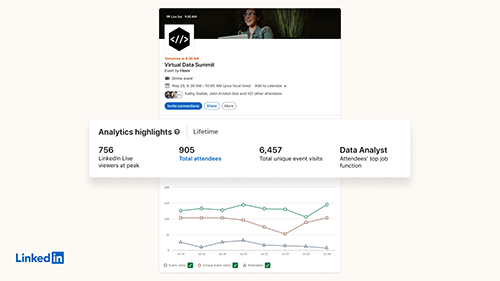
If you’re among the businesses using group and community meetings or events as part of your marketing strategy, Linkedin’s Event Ad feature will help promote your event to a new audience, highlighting key details such as date, time, and how to join.
It will also let members know if a mutual connection will be attending, so watch out for talking at the back.
That’s smart enough on its own, but Linkedin’s new features also include an Event Analytics tool that offers insights into the reach, engagement, and companies behind event attendees, crucial information for tailoring or targeting future events.
LinkedIn Live gets a boost
Business owners looking to get in on the livestreaming trend went crazy for Linkedin’s Live feature, which saw a more-than 400% YoY increase in the past 12 months or so.
The chaps at the business platform have taken note and unveiled Custom Streaming, a nifty feature that allows members to use the broadcast tools they are most comfortable with, whether that’s Zoom, WebEx or OBS. If Microsoft Teams is your bag, that’s on its way too.
Measure performance on the Go
Linkedin has finally realised many business owners aren’t chained to their computers 24/7 and can get out and about from time to time.
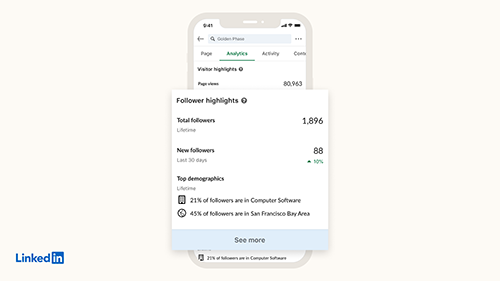
With that in mind, they’ve launched Mobile Page Analytics, sending all the visitor, follower and content insights, including organic and boosted metrics, normally accessible on your desktop, straight to your phone.
If you’re still struggling to get to grips with Linkedin’s new features, give us a shout and we’ll soon have you LinkedIn-ing like a pro.
We’re 24 fingers, a digital marketing agency and a proud member of the 42 Club, Brentwood Chamber of Commerce, Excel Business Networking Group, the Trusted Business Community, the Organisation for Responsible Businesses and the Rotary Club of Brentwood à Becket. We help companies who are all fingers and thumbs with their social media grow their business and brand. Book your free strategy call here.
Instagram has always had a mobile-first approach. Which is great, if you’re out and about and using the app as it was originally intended, to post insta(nt) photos of what you’re up to. But let’s face it, it’s no longer 2010, and in the last ten years or more, many of us are now seeing the benefits of using Instagram for our businesses. As such, wouldn’t it be really, really handy to occasionally be able to post to your Instagram feed from your desktop? Well, we’re here to tell you that with a click of one of our 24 fingers, it’s no longer a pipe dream.
Instagram plans to allow for desktop posting
Although there are lots of features that can be used on Instagram from your desktop, annoyingly, the most important aspect of the platform – posting photos to your Instagram grid – isn’t one of them. Rumour has it though, that Instagram is currently planning to allow users to create posts from their desktop. There are reports that Instagram is working on including a button to post photos directly from your desktop to your Instagram feed.
Initial ideas and images suggest that users will then have the opportunity to edit the image, as you do on the mobile app. This includes choosing the aspect ratio of your image and picking filters, as well as the expected options to add a caption, tag people and add your location information.
Our 24 fingers will be poised to give Instagram a massive high five if this functionality is rolled out to desktop users: it’s been sorely missed by many a business owner who prefers creating social media content from the desktop, for example if your images are stored on an online server or if you’re simply more efficient on desktop than mobile. So let’s keep our collective fingers crossed that Instagram give it the green light.
And until then, how can you post to Instagram from your desktop?
Although it will be fab if Instagram roll out the ability to post from your desktop, this all very much appears to be in the initial stages at the moment – if it happens at all. So until then, what can the desktop lover do to make Instagram work for them?
Well, there are ways and means around it. And our 24 fingers are tapping away at the computer keyboard constantly, making them work for our clients, and regularly posting from the desktop. We may even have our ways and means of posting to your stories from the desktop, too.
Want to know more about how you can post to Instagram from your desktop? Get in touch and you’ll be just a few short clicks away from posting to Instagram directly from your desktop.