Read

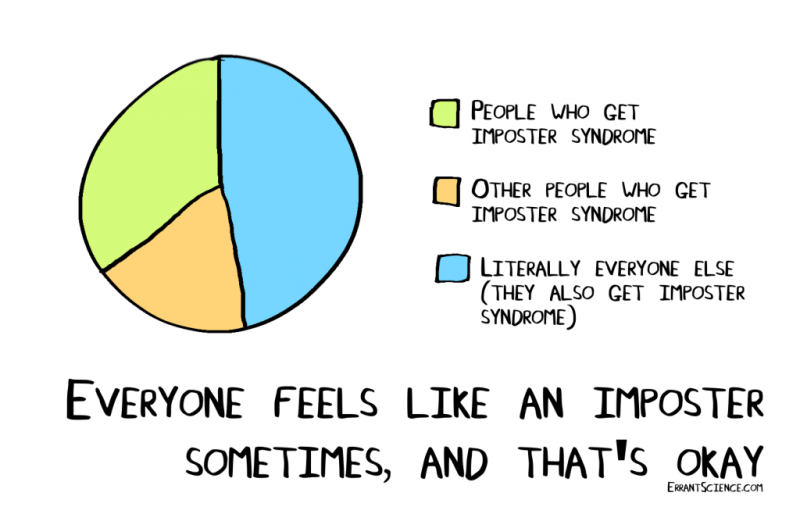
Seven tips to beat imposter syndrome

NatWest Business Builder: Understanding your mindset

Feeling like a fraud as founder can be crippling, so here’s how you can tackle the dreaded imposter syndrome.

According to a survey published last month, the Microbusiness Index, a third (33%) of female micro-business owners in Scotland doubt their achievements.

Across the whole of the UK, around two thirds of SMEs say they have suffered from imposter syndrome and a fear that they’re going to be exposed as a fraud, or so found a 2017 study carried out by AXA Direct. Furthermore, women are more likely to admit to feeling like an imposter – 74% compared with 58% of men – and 44% of business owners say the self-doubt they’re plagued by is intense enough to be called a daily companion.

Suffering from imposter syndrome is often exacerbated by the fact that business owners may not have anyone to speak to about their concerns. Here, SME owners share their experiences and advice.

1. Age is just a number

Rachael Dunseath is the founder of Myroo, a plant-based skincare brand for sensitive and allergic skin. She launched the company just over two years ago, having previously had a successful career in financial services marketing.

“I knew it was a great idea – my research showed that the market needed these products – but I was so unsure about taking the leap,” she says. “My imposter syndrome hit its peak when I landed a place on an accelerator programme. I was surrounded by younger, more dynamic entrepreneurs, who were taking risks, being brave and hustling.”

While Dunseath is in her early 40s, many of her fellow entrants on the programme were in their 20s. Over time, Dunseath has found that a coping strategy has been to forget about her age and focus on what she wants to achieve instead.

2. Remember: Rome wasn’t built in a day

A lack of skills particular to your business can seem daunting. For Nikki Hollier, owner of Border in a Box, a ready-made garden border template kit, it was her perceived lack of plant knowledge and general horticultural skills that she believed was holding her back.

“I worked in corporate IT for two decades and recently retrained as a garden designer, so I’m always concerned about not being good enough,” she says. “I’ve learnt to deal with it by reminding myself that Rome wasn’t built in a day.”

What this means in practice is focusing on improving the skills needed to make the business a success and, in time, you’ll find that people will start to take you seriously, explains Hollier.

3. Break down daunting tasks

“I always think of it [imposter sydrome] through the lens of the common mountain analogy,” says Callum Hemsley, co-founder and CEO of Eola, a platform and marketplace for adventure sports and outdoor activity centres.

In the analogy, the mountain is a big task that needs to be navigated and overcome to reach a destination or end goal. Hemsley says that if a particular task is too daunting and is heightening your imposter syndrome, then it’s helpful to break the task down into manageable chunks.

“Doing this reduces the feeling that the whole cannot be accomplished and makes your targets seem within your capabilities,” he says.

4. Enter awards

Dunseath and Hollier are in agreement that entering awards can not only help your business to gain recognition, but also give you confirmation that you’re doing a great job.

““The company had won awards before, but I’d managed to explain those away. This was a huge, national win, though. Even I couldn’t take the shine off that”

Rachael Dunseath, founder, Myroo

“I won Micro Business Entrepreneur of the Year at the 2016 Great British Entrepreneur Awards,” says Dunseath. “The company had won awards before, but I’d managed to explain those away by telling people that not many others had entered. This was a huge, high-profile national win, though. Even I couldn’t fully take the shine off that.”

While losing out on an award might feel demoralising, it shouldn’t be seen as a setback. Instead, you should use it as an opportunity to enter more awards – to seek the recognition you believe your business deserves, argues Hollier.

5. Don’t be afraid to market your business

Helen Campbell, a business mentor and PR coach to SMEs, says that one thing is clear from her experience of dealing with clients: many business owners and founders tend to be reluctant to promote themselves.

“A lot of them are in a loop where they feel awkward about self-promotion, but if they don’t market themselves they bring in little-to-no work, which then worsens the imposter syndrome,” says Campbell. “In some cases, this lack of promotion will lead to the business failing. It’s important to remember that marketing your business is not boasting. Not showing off your skills and expertise, however, can stop you from reaching your potential.”

Campbell’s advice is to find your own authentic style and a way of promoting yourself that feels right for you, amplifies your talent and aligns with your company’s values.

6. There will always be doubters

Regardless of success, there will likely always be those who’ll doubt you.

“It’s best to avoid these people, as they can bring your confidence down quickly,” says Hollier. “But while some are very mean-spirited, equally, there are some who are absolutely wonderful, so make sure you surround yourself with them.”

7. Ask yourself: what’s the worst that could happen?

In the two years it’s been running, Myroo has grown its team and its products are stocked up and down the country, including in stores of fashion chain Anthropologie. Myroo is also about to announce a significant international account.

“I do still battle the imposter demons, but I’m getting better at knowing how to handle it,” says Dunseath. “And I now realise that failure can be a good thing as long as you learn from it. My mantra is: ‘What’s the worst that could happen?’ The reality is usually not as bad as you think.”

Further Reading

  • SME Tools: maintaining focus
  • Management strategies: overcoming imposter syndrome
  • The five traits of success

We have a thriving and diverse community of thousands of entrepreneurs from multiple sectors, backgrounds and skill sets helping you to connect with the right people at the right time. No matter whether you’re looking to upskill, get feedback, engage with new people or simply observe, there’s something for everyone.

‘Want to learn more? Register for NatWest Business Builder to view all of their business development tools. Click HERE

Five laws of disruptive business thinking

NatWest Business Builder The Importance of Mindset

Disruptive businesses make a big splash in the media, but how does the thinking behind them come about? We look at the key rules of disruptive business thinking.

The word ‘disruptive’ used to refer to poor behaviour in the classroom, or the impact of strikes on the railway. But the tag is now far more likely to be linked to new types of business, where market value often outweighs investment and costs. Both Uber and Airbnb entered the already crowded markets of minicabs and holiday lets, but their rethinking of the entire model was what saw them race to the top at a pace traditional businesses could only dream of.

The media can’t get enough of them, and their business growth was largely driven by digital-native millennials who had the technology. Both are now large enough to commission television ad campaigns and PR drives to mop up the older generations.

So how can other start-ups in diverse sectors use this model to dominate (or at least radically change) the marketplace?

1. Find the gap in the market

Finding the gap may require mentally dismantling your target market and rethinking it from scratch. How would you start if you were the first one into the market, or what can you do that no one else can? Uber has as many detractors as fans (as is often the case with disruptive models), but there’s no denying it does away with the lottery of knowing which cab company to ring for the fastest and cheapest journey.

“Disruptive ideas come from having an attitude to challenge and push to improve established ways of doing things,” says Jas Bagniewski, CEO of innovative mattress retailer Eve Sleep. “I think if you try to improve every aspect of an industry, becoming disruptive is inevitable.

“When we started, we looked at how we could improve every aspect of the traditional mattress-buying experience. That way of buying – going into a showroom and lying down awkwardly for 10 minutes – is broken. We offer a better experience for customers because you can buy online quickly and easily, we offer next-day free delivery and you have 100 nights to try the product. By selling direct to customers, we can also offer a premium product for a better price.”

2. Be a true original

The first thing any business will need to do is ape the old Apple slogan of ‘think different’. It may be a business-speak cliché to speak of thinking outside the box, but disruptive entrepreneurs need to do little else in the initial stage of their start-up. Without that spark and a USP, their business is just another ‘me-too’ company that could simply get lost among the competition.

True disruptive thinkers and entrepreneurs are few and far between. So great ways to disrupt often come from teams of thinkers coming together to create a business, or outside experts being brought in to rethink a market. You want the kind of idea that makes people wish they’d thought of it.

“I think if you try to improve every aspect of an industry, becoming disruptive is inevitable”

Jas Bagniewski, CEO, Eve Sleep

3. Solve a problem

“Ours was a consumer problem rather than a gap in the market,” says Tom Cavill, co-founder of property investment business Bricklane.com.

“We started with the problem that we and many friends had, then worked hard on an innovative solution. Before Bricklane.com, you either had to scrape together a huge deposit and invest all you had with a mortgage, or you were shut out of the market. We allow you to own a stake in a property [with others], whatever your situation.

“We feel we’re disrupting several markets: we allow first-time buyers to keep up with the market as they save and allow those who can’t or don’t want to buy to receive the financial benefits of ownership. Renters living in our homes also get better service and stability than is average in the market.”

4. Don’t forget the small print

It’s easy to see disruptive thinkers and doers as the anarchists of the business world, but none of them would get anywhere without considering the legal or ethical implications of their new ways of thinking and working.

If you’re testing the boundaries, you can be sure lawyers will want to as well, especially when people start putting large valuations on your business. Make sure the way you wish to operate complies the law and financial regulations because small slip-ups can be costly. If your app is bumped from app stores for minor violations, you could be set back by months.

5. Think about time efficiency

Millennials drive the market for disruptive business and famously want everything done now, whether it’s their food delivered or their finances sorted.

Airbnb took a concept that was only accessible on obscure community pages and brought it to the fore, saving hours of searching and competing with hotels along the way. If you can reduce complex tasks to a couple of clicks, you could be on to something.

“We’re disrupting the automotive retail space by consolidating the customer journey of buying a used car,” says Maximilian Vollenbroich, co-founder of Carspring.co.uk, a business that allows you to search for the car you want, find financing and arrange delivery of your pre-checked motor all in one hit. “Whereas a consumer would have to do transactions with multiple parties – from the dealer, financier, insurance and warranty provider and breakdown cover – at different places and times, we enable them to sort this all in one place.”

Further Reading

  • SME Tools: how to be productive
  • Eight business habits to break
  • How to create the right mood

Join the Business Builder Facebook Community here

‘Want to learn more? Register for NatWest Business Builder to view all of their business development tools. Click HERE’ 

Halt! Who goes there?

Brian Bush Online Imposter Syndrome

Impostor syndrome (also known as impostor phenomenon, impostorism, fraud syndrome or the impostor experience) is a psychological pattern in which an individual doubts their accomplishments or talents and has a persistent internalized fear of being exposed as a “fraud”.

Weirdly while many people struggle with imposter syndrome, many people discuss it and there is lots of content around detailing the issue the ‘owner‘ often feels very alone in their feelings. Those feelings may include the idea that you don’t belong, that you are a fraud and this will be discovered and you will be ruined and shamed, that you don’t deserve your job, friends, business or any success.

First identified by psychologists Pauline Rose Chance and Suzanne Imes in the late 70’s much research and new knowledge has developed since. Initially thought to affect women only opinion among the psychology field soon balanced out the issue across the sexes and also attached the effect to all sorts of people .

I know in my own experience I have had these feelings occasionally and they have also at times held me back from doing things. Challenged my own beliefs in myself and had me feel like a fraud for no fraudulent behaviour at all. Like seeing a police officer and worrying you have done something when you know full well that you haven’t.

I also know people who are exceptional at what they do and struggle with this and according to the International Journal of Behavioral Science an estimated 70% of people experience these feelings at some stage of their lives.

So what do we do? Live with it, ignore it or cure ourselves. Of course there are different strokes for different folks and ultimately we control the onset of the thoughts that trigger the emotions. We can therefore review the thoughts and question them as they arrive and then frame our thinking differently to oppose the negative pattern. We can learn to think like non-imposters says expert Valerie Young

In my coaching work I find that investigating the issue using evidence helps as you must support the negative pattern by proving it actually exists. So if someone is struggling with this aligned to feeling inferior as a team manager for instance what evidence supports their claim? Proper hard evidence and not just negative self assumption. Are they getting complaints or constantly underperforming and this is being picked up in assessments or by their manager? If no real evidence supports this then it can be discussed to identify that this is a self developed emotion triggered by self doubt and then dealt with relevantly to the individual.

People struggling can be encouraged to share their thoughts with others to reassure them that they are not alone and in fact the people they assume to be successful may be triggering those same thought patterns themselves.

So most importantly we will all have moments of doubt and this is perfectly normal and the aim is not to think that you should never have these moments but to equip yourself with the knowledge and techniques to balance yourself out again. Again to Young who states that you can still have an imposter moment, but not an imposter life.

You can view this article from Brian Bush, Business Growth Specialist here

Introduction to Understanding your mindset

NatWest Business Builder: Understanding your mindset

In this module we’re going to explore some of the key characteristics and behaviours of fixed and growth mindsets to give you a deeper understanding of each mindset and their overall effect on a person’s ability to learn and develop. We’ll also give you a simple tool to help you recognise some of the positive and negative behaviours surrounding your mindset, and start to look at some of the factors that are stopping you from adopting a growth mindset when faced with certain situations.

In this module you’ll explore:

  • Key characteristics of fixed and growth mindsets
  • How to recognise different behaviours of each mindset
  • What’s stopping you from adopting a growth mindset

Start by downloading and saving the workbook to your computer, to use throughout the module, capturing any key takeaways and completing the exercises at the end of each chapter.

Characteristics of fixed and growth mindsets

We know mindsets have a major influence on people’s ability to learn, and those with a growth mindset tend to learn, grow and achieve more than those with a fixed mindset. But why?

In this chapter we’re going to look at the key beliefs and focus of each mindset to understand this further.

Understanding your mindset

In the next chapter we are going to introduce you to a simple coaching tool to help you recognise some of the key behaviours of adopting a fixed or a growth mindset at any one time, as well as hearing from some fellow entrepreneurs about their own experiences.

What stops you from having a growth mindset?

We now understand a little more about the characteristics and behaviours of each mindset, but what fundamentally stops us from having a growth mindset 100% of the time?

In the final chapter we’re going to explore the science of this in more detail, reflecting on your own inner voice and some key ways to manage this.

Further Reading

  • SME Tools: maintaining focus
  • Management strategies: overcoming imposter syndrome
  • The five traits of success
  • Seven tips to beat imposter syndrome

We have a thriving and diverse community of thousands of entrepreneurs from multiple sectors, backgrounds and skill sets helping you to connect with the right people at the right time. No matter whether you’re looking to upskill, get feedback, engage with new people or simply observe, there’s something for everyone.

‘Want to learn more? Register for NatWest Business Builder to view all of their business development tools. Click HERE

What the Supreme Court ruling on Uber drivers means for UK employers

Price Bailey

In 2016 the Employment Tribunal heard a case brought by Uber drivers James Farrar and Yaseen Aslam, who believed that they should be regarded as workers. The tribunal found in favour of Farrer and Aslam. This decision was later upheld by both the Employment Appeal Tribunal (2017) and the Court of Appeal (2018) and now, most significantly, the Supreme Court.

On 19 February 2021, the Supreme Court handed down its decision after hearing the appeal on behalf of Uber back in July 2020. The ruling now means that Uber drivers can access the rights afforded to workers.

This decision is significant for the gig economy, which is forever growing. By recognising the drivers as workers, they can now access statutory rights such as national minimum wage and paid holiday entitlement. This is clearly the more significant element of the decision for those who work within the gig economy. Still, more noteworthy for employers more broadly is the way by which the Supreme Court reached its decision.

The Judges explained the importance of considering the reality of the drivers’ working practices and the relationship with Uber rather than being bound by the written agreements. As employment lawyers, we have flagged this as a key “takeaway” from this decision because it is important for businesses to review the documentation and contracts that they have in place for workers and contractors to ensure that these reflect the true working relationship and to make sure that they are accurately interpreting the classification of those working within and for their business.

The criteria that the court looked at included the level of control that Uber had over the drivers.

For example,

  • how work is given to the drivers and the nature of any disciplinary and dismissal procedures,
  • restrictions imposed on the drivers by Uber, such as the drivers’ inability to form alternative contracts with passengers outside of Uber,
  • the fact that Uber sets the specific terms and conditions of the service, including dictating the fare and therefore ultimately how much the drivers could earn,
  • drivers face penalties for cancelling or not accepting rides – sometimes preventing them from working.

This ruling will have future ramifications for businesses that use a similar business model and will open the floodgates to claims from those who will now be able to apply this precedent case to their own employment status. This leaves the gig economy vulnerable to significant obligations to pay back pay and compensation if successfully claimed.

This case highlights the importance of correctly identifying workers and contractors’ employment status by looking at the relationship in practice. Misinterpreting the relationship can be significant for businesses. Should you want assistance with reviewing your workforce’s status, Price Bailey Legal Services can carry out a workforce audit to ensure that your contractors are truly contractors.

We always recommend that you seek advice from a suitably qualified adviser before taking any action. The information in this article only serves as a guide, and no responsibility for loss occasioned by any person acting or refraining from action as a result of this material can be accepted by the authors or the firm.

 You can view this original Price Bailey article here

Matching People to Jobs

Professor Colin Lindsay, University of Strathclyde and the PrOPEL Hub

There has been much discussion of the need, and opportunity, to build back better following the Covid-19 crisis. While much of the focus has rightly been on responding to the coming unemployment crisis, there is also a sense that we need to grasp the opportunity to create a ‘new normal’ that addresses some of the long-standing inequalities in the UK labour market.

One recurring problem has been that of under-employment – where workers want and need more paid hours but are not able to secure them. In late 2020, it was estimated that more than 3.5 million UK workers were under-employed (approximately 8.7% of the labour force).

The consistently high numbers of people under-employed is a problem that needs a fix as we re-boot the UK economy post-Covid-19. A recent analysis of EU and US data by David Bell and David Blanchflower suggests that under-employment contributes to limited pay and career progression for some workers. This adds to a growing evidence base that under-employment can impact negatively on employees’ wellbeing; contributes to in-work poverty; and limits opportunities for learning and progression. These negative impacts on employees contribute to socio-economic inequalities and may undermine the performance and productivity of organisations, sectors and regions. So, understanding the drivers of under-employment is important. 

The Universities of Strathclyde and Portsmouth, funding by the ESRC Productivity Insights Network, have been researching the distinctive drivers and impacts of under-employment in different areas of UK, and how the workplace practices adopted by employers either contribute to or help to alleviate the problem. Head over to https://www.propelhub.org/matching-people-hours-and-jobs-building-back-without-under-employment/ for more on the research and to watch the research team discuss findings at a recent webinar.

Time to Take Responsibility

Swarm

I have just read an article in Business Matters on apprenticeships, and how a survey of 2000 small businesses, appears to highlight a move away from hiring graduates, to apprentices.

As with all surveys, I always question the sample used, and this one did not clarify which types of business they spoke with, or the context in which the questions were asked. Although the picture of two young lads intently hovered over a metalwork lathe, may indicate (even if not actual) the perception of apprenticeships, even today. However, the findings highlighted, did open an interesting debate.

The first point made was 57% of these small businesses would now hire an apprentice at entry level, rather than a graduate, as they believed a degree had decreased in value over the last ten years. No explanation was given to why they concluded a degree was worth less, or what this may be linked to. On one hand this may prove encouraging in respect of how apprenticeships may now be perceived, on the other hand, if the old perceptions still hold true, are apprenticeships now seen as a cheaper employment option?

There may be a hint in findings further in to the piece, where it is reported that only a quarter of those questioned had taken on an employee from a school/University between 18-24 years of age in the last two years, and that half of those had reported a poor experience. The poor experience had come through; lack of skills, incorrect attitude and no commitment. Therefore, if they had been paying graduate wages for a poor experience, a cynic may suggest that the thought process leads to, ‘why not pay an apprenticeship rate, and if the experience is still poor, at least it has not been so costly’!

However, I am ever the optimist, and still believe that most people do things for the right reasons, even if the circumstances that they find themselves in does not always make it look that way.

Possibly, one of the most telling pieces of information, was that although 86% of small businesses were worried about youth unemployment, over a third of them thought the problem of solving youth unemployment was down to the Government. The survey then reported that small businesses thought that schools and young people were more responsible than the small businesses themselves.

With over twenty years’ experience in running small businesses, I have, in part, some understanding of why small business owners may feel this way. The life of a small business owner is a complicated one, in one of my businesses, we had twelve staff, a mixture of full and part time employees. I often reflect on those times, and how it was staff issues which took up a lot of management hours. Training and maintaining staff is a skill, and one which many small business owners struggle with. And why wouldn’t they, as with my own businesses, we have a perplexing amount of things to deal with, and the moment the business grows to a point where it needs employees, it can seem as though the lid on Pandora’s box is slowly creaking open, to expose the horrors inside.

That is why it is time for some joined up thinking. Shaun Thomson, CEO of a UK training company identifies that small businesses must put processes in place to identify applicants that show the right attitude. However, it is my own belief that it is more complex than that, and with the current business environment placing ever increasing pressures on those businesses, even if a business owner has identified this course of action, implementation may be a different matter entirely.

That is why the interaction between Government, businesses and apprenticeship providers is crucial, not only in respect of the apprentices, but also the businesses they enter.

On the Government side, they have now at least recognised the importance of training for the future, with the launch of the apprenticeship scheme. Good apprenticeships providers are now using their skills to allow not just young people, but people of all ages to obtain needed skills, and the qualifications to back those skills up. What is now really needed, is for small business owners to complete the triangle, and with the assistance, guidance and knowledge of those providers, create not only a completely new look work force, but also create the leaders of the future.

We all need to play our part, all three legs of the stool need to be in place, if not, it will quite simply fall over. The Government needs to keep good structure in place, and the funding stream available. The providers need to be high quality, and passion driven to deliver what is, a life changing product. And last, but certainly not least, small businesses need to recognise that their role in this is huge, not only for the apprentice, but also for themselves.

If we can achieve this balance, it is my belief that the future is very bright for all concerned.

Harry Harris

For more information, or just to have a chat contact Swarm Apprenticeships on: 01953 609752 or email harry@swarmgroup.og.uk

Are you looking for a new job in 2021?

Support from an expert recruitment consultant could really improve your chance of finding a great role, especially when so many people are looking for a new job.

Support from an expert recruitment consultant could really improve your chance of finding a great role, especially when so many people are looking for a new job. So what should you look for in a good consultant and how can they really make a difference?

Based on our own candidate feedback, here are the top five priorities people were looking for when they approached us for help in finding their next career step.

QUALITY OF ROLES

Every year, over a thousand of our region’s businesses trust us to help them find the right people. This means we have a host of quality roles at all levels within our specialisms of Accountancy, Human Resources, Technology, Marketing & Digital and Professional Office. This includes being able to put candidates forward for roles they may not otherwise have heard about, but which we are aware of because of the long term relationships we have built with local employers. Our approach is also firmly focussed on quality over quantity. We don’t just send out candidate CVs to as many places as possible. We take the time to understand the needs of both our clients and our candidates so that we can match personalities, values and cultural fit as well as skills, attributes and experience. We never put anyone forward for a role we don’t genuinely think they are suitable for.

“3 months into my 6 month FTC and this week I got offered the permanent role. To say I am pleased is an understatement. Thank you Mark Wishart for helping me find my new home!”

FRIENDLINESS AND PROFESSIONALISM

Putting yourself ‘out there’ and job hunting can be daunting. Having the support of a friendly consultant gives you extra confidence as well as the benefit of their professional expertise. Our consultants are all experts in their different disciplines and have extensive experience of recruiting in their industry field. They are well placed to understand the type of role you are looking for and to act as your ambassador when promoting your skills and experience to potential employers.

“After losing my job in October due to COVID, I am extremely pleased to say that I have secured a job for January! To say I’m elated is an understatement and it is all thanks to Rachel Thorogood at Pure! Not once, but twice Rachel has been there to save my bacon! Please, if you are in need of a new job in Accounting give her a message! Cannot wait to start my hopefully, lifelong career in January 2021!”

INFORMATION AND BRIEFING BEFORE AND AFTER INTERVIEWS

Our expert consultants are on hand to support you at every stage of the recruitment process. While you may be updating your CV for the first time in years or going for your first interview in a long while, this is what our consultants are supporting people with every day. They have plenty of experience to draw upon when advising on how you can really stand out to potential employers. They will make sure you have all the information you need, give you top tips and bolster your confidence where needed. 

“From the offset, Miranda has been nothing but supportive and encouraging, sharing her advice and expertise with me. Miranda even went above and beyond to help tailor the position to suit me and my needs. Miranda has always been on hand to answer any queries or concerns and when needed, negotiating terms of the placement, she would be in contact every day and often multiple times a day to get things sorted. I have been nothing short of amazed by the service offered by Pure and would like to pass on my thanks to particularly Miranda, Lewis and Kelly. ”

KNOWLEDGE OF THE LOCAL MARKET

One of the key benefits of working with a recruitment consultant is their insight into the local job market. Our consultants invest time in becoming experts in their specialism, as well as the local area, and really have the knowledge needed to help you find the right role for you. Our specialist sector knowledge is one of the main reasons candidates and clients alike choose to work with us.

“I have known Becky for many years as both a candidate and a client. From the candidate’s perspective, I could not have wished for a better recruiter. She is truly outstanding. Becky goes above and beyond to really understand the candidate’s needs to ensure that the role she is placing them in is the right fit. So therefore when I have been the client and having candidates placed within my team I know that Becky would only put forward those that she truly believes would fit the organisation’s requirement in terms of experience but also the existing team dynamic. In a world of recruitment, especially in these current times, it is so refreshing to be able to know that Becky’s moral compass still plays such an integral part in the relationships she has with her clients and candidates.”

POST RECRUITMENT COMMUNICATION

Our consultants don’t just walk away once they have placed someone in a new role. We stay on hand to support you through the first 100 days in your new job and to help you transition into your new position and company.

“All the consultants were very helpful and supportive, both during the recruitment process and after I got the job. I really appreciated the ‘settling into your new job’ advice document.”

We are proud to say that our feedback showed that 98% of our candidates rated us as good or excellent in 2021 and 100% would use us again. For more information about how we could help you with your job search in 2021, and for details of the jobs we are currently recruiting for, contact our consultants today.

Brexit: Employing EU citizens in the UK

Steeles Law Solicitors

James Conley, Solicitor - Employment
James Conley, Solicitor – Employment

The UK is on course to leave the EU single market at the end of the year, which means the end of free movement of people too. Despite this, the Government has stated its commitment to protecting the rights of EU nationals and their family members who want to remain in the UK after Brexit.

It is in businesses best interests to take proactive steps in advance to ensure their employees retain the right to work in the UK and avoid business interruption.

EU Settlement Scheme

The EU Settlement Scheme (Scheme) has been set up to create a mechanism to support employees and requires UK based EU nationals to register to preserve their rights under UK law. This includes the rights to work, pensions, and healthcare.

It is vital that businesses assess whether, and to what extent, their workforce will be affected by the Scheme. EU, EEA or Swiss citizens and their family members who are living in the UK before 1 January 2021 need to apply to the EU Settlement Scheme to continue living in the UK after 30 June 2021.

How to assist your EU national employees

Make sure your workforce understands the steps they are required to take to lawfully be entitled to remain in the UK. This will depend on how long the employee has lived in the UK at the time they register.

  • Settled Status

EU nationals residing in the UK on or before 31 December 2020 with five years of continuous residence in the UK can apply for a new ‘settled status’ which will be similar to ‘indefinite leave to remain’ under current UK immigration law as it applies to non-EU nationals.

  • Pre-Settled Status

EU nationals residing in the UK on or before 31 December 2020 with less than five years of continuous residence in the UK must apply for a ‘pre-settled status’ to remain in the UK after 31 December 2020.

  • Non-EU Family Members

Non-EU family members of EU nationals who are residing in the UK before 31 December 2020 must apply for ‘pre-settled status’ or ‘settled status’ to protect their continuing rights to live in the UK after ‘exit’ day. It is also possible to bring non-EU family members living abroad to the UK provided that the relationship exists on 31 December 2020 and continues to exist when applying.

Contact us

 To find out how Steeles Law Employment team can support you and your business, please do not hesitate to call 01603 598000 or email employment@steeleslaw.co.uk.

*The information provided in this article is designed to provide useful information on the subject, not to provide specific legal advice.

We think you may also find this interesting: Is Your Business Brexit – ready?

Is it worth being an Entrepreneur or Angel in the UK?

Magic Sauce

Ok, so that headline was a little hyperbolic.

Beauhurst published results of a survey on the feelings of the Startup ecosystem in the UK with regards to possible government plans to overhaul CGT (Capital Gains Tax) on share disposal.

Currently, when a founder exits a business the first £1m of the proceeds is only subject to 10% tax, with the rest subject to 20% in most cases.

The government is proposing a 45% tax on disposal of those assets. 

This would make it the highest in Europe, with all of the consequences that entail.

1. 85% of those surveyed said that they’d set up in another, more favourable location (in tax terms).

2. 88% said that jobs would move abroad.

3. 90% said that it would be harder to attract top talent.

4. 72% of Angels said they would be less likely to continue to invest in UK companies.

All of these scenarios would be catastrophic for the UK at at time when financial stimulus and innovation is needed most.

The high growth sector of the UK economy employs 3.5m people, all paying income tax, national insurance and VAT on whatever they buy.

Those companies would definitely have brought a proportion of inward investment to their businesses throughout their growth (which is then spent on staff, services provided by UK companies, etc.). 

Let’s use back of a napkin maths. Let’s say that each person working for a high growth company (mostly well paid jobs) pays £16666 through the year in income tax, NIC and stuff like VAT.

That’s worth £58bn to the economy annually. 

That doesn’t account for those fast-growing companies that have been acquired and now form part of a larger corporate machine.

This doesn’t account for the increase in spending a tech platform may encourage, or business efficiencies and productivity gains it may provide.

What none of these things mention is the risk that founders take to gain the potential high rewards that a tech platform scaling and then being acquired or going to IPO can bring.

Quite apart from the toll on mental health, it causes relationship break ups, debt, sleepless nights. It’s not a 9-5 job. People are putting their reputation, savings and everything else on the line (and the burden of responsibility that any good founder feels when they are invested in by outsiders).

To try and bracket that risk and the tax on the reward on the same level as an employee in a well paid 9-5 job is an insult, a deterrent and could stifle an entire generation of innovators (or force them to another country to try their luck).

Look across the pond to the US. 

A tech founder could realistically exit their business and not pay a dime in tax on the first $10m of the sale of their shares in their own company. They’d pay 20% on the rest. That incentivises both investors and founders to innovate and scale a business. 

Having the highest CGT in Europe does not.

It will harm more than just this current generation too.

Every founder I’ve ever met on my journey that’s made it to a pre-seed investment has a purpose of some kind. Ultimately, every single one of them wants to be an Angel investor themselves one day and ‘pay it forward’. That paying it forward is critical to the circular economy within the tech landscape. People get invested in, they grow a company, and if they have enough money they become an investor themselves to seed the next generation of tech companies.

Living in Norfolk, one of the things that caused a lag in the growth of the tech Startup scene here initially was the lack of exits. An ecosystem cannot exist without successful ex-founders who choose to reinvest in that cycle.

80% of the people surveyed by Beauhurst said that they would be unlikely to reinvest. Liquidity on disposal of a Startup is critical to the growth of further innovation and Startups in the UK. 

We’ve already lost jobs from large companies due to Brexit, we’ve lost entire companies due to Brexit. If the government thinks it can rely on those corporates to maintain the country in a post-Brexit, post-Pandemic world, it’s deluded and smacks of the same overconfidence of many high street retailers who failed to change the way they do things and adapt to the new behaviours of its’ consumers.

We get that we have to reduce the borrowing that has spiralled thanks to the pandemic to offset the measures put in place to keep people in jobs. That money shouldn’t have been spent propping up ailing, dying giants in the form of large high street retailers that were going to die anyway. It should have been spent upskilling or helping people transition into better paid jobs in the digital sphere, for employers that would truly value them.

If anything, we need to seed the environment to create more high growth companies and the jobs that go with them. Imagine if we could double the amount of high growth companies in the UK over the next 5 years?

That would look like over £100bn in tax revenue for the UK, jobs created, inward investment pouring into the company paying for the growth of those companies, more confidence from the investment community to invest in those companies, more people paying it forward, more Angels, more people able to invest in VC funds and lending…

We also have to remember that a lot of the Angels that have helped grow the sector until now have been ex-corporates and landowners who’ve levied their assets to invest. That can’t go on forever, especially as we’re seeing more people turn to spread betting lower amounts via crowdfunding rather than getting involved.

The alternative is dwindling confidence that the UK is a hotbed of innovation that attracts more inward investment into Startups than any other country in Europe. People start to switch off, people lose the aspiration to do things that could improve processes, governance, the climate, stimulate consumer spending.

Don’t raise CGT.

Offer high growth companies (up to) the first £5m of their disposal free of ANY tax (on a disposal of £50m). Tax them at 20% for the rest. Sure, put a caveat in that the £5m is only tax free because it’s ringfenced for reinvestment. 

If we tiered (the government likes loads of tiers, I’ve noticed that) that tax so that it represents 10% of the value of that disposal to an individual it means they’re likely to either start a new company with money behind them or invest in others.

At the bottom end, even if someone benefited from the sale of a company to the tune of £5m, they’d be tax free on the first £500k, with 20% being levied on the rest. The total tax to pay would be £900,000 (instead of £2,250,000). Would that encourage an entrepreneur to start again or invest in others at £25k a pop? Don’t sit there scratching your arse and thinking because the answer is yes.

The other thing that needs regulation is the amount of founder equity that some universities are taking in the UK. They should be capped at a maximum amount of 25% of dilutable equity. There is so much IP floating around the Universities that’s been left to rot due to ignorance/greed of Universities. No-one will invest in a startup that has 50% of the IP and founder equity belonging to a non-active partner. Stop it.

You can get in touch with Magic Sauce here

We think you may also find this interesting: RESTART Festival | Angels Den pitches

White paper: Delivering Virtual Work Experience and enriching work experience through digital media

Morgan Sindall

In our latest white paper speak to those involved in our online work experience. A programme devised by the team in our East region, when their latest group of work experience placements were unable to begin their placements due to the Covid-19 pandemic.

By moving the programme online, the students were still able to gain valuable experience and learn new skills.

Find out more about the programme as we hear from the students, their parents, their teachers and the Morgan Sindall Construction team, download the report here.

To view the original article click here

Why Startups Fail & How to Avoid it

Magic Sauce

The research tells us that pre-Covid, 90% of startups fail (that includes all startups). 

There’s a nice, confidence raising figure for you eh.

20% in Year 1, 30% in Year 2 and the rest in years 3-5 (if you can’t do the maths on the last bit then you should definitely get a CFO as your first co-founder).

What those stats don’t tell us is ‘why’?

WHY?

There’s a myriad of reasons, but the most common are:-

Poor management

Cash Flow

Lack of Funding

Poor market/product fit

Founding team implosion

Covid (and an inability to pivot to the ‘new normal’)

Some of that stuff is surmountable, some of it not. 

Fintech for instance has had a huge focus in the post-Covid world, so I could just tell you to go build a fintech platform because investors are desperate for deal flow in that area. You may get money but still fall foul of all of the other reasons above, so let’s tackle those in brief.

Poor Management

The stats tell us that a startup with more than one founder is more likely to gain funding and it’s more likely to succeed. Accept your limitations and try and find a team to fit around you that make up for the skills you don’t have or could improve upon your ‘gifted amateur’ skills. I know this because I’ve been a lone founder and it’s (as the name would suggest), lonely. It also means that you don’t have a ton of cash for experts to do the stuff you’re rubbish at (at least at the start). It’s taken me time but diarising stuff and to-do lists really help to motivate you do the stuff you hate doing. I still push stuff down the list, but I’m getting better at it. You also need to remember that as you build a team, you need those people to buy into your vision. If you’re talking to prospective co-founders or employees, really dig into what they want now and in 3 years (don’t necessarily give them your vision in any detail beforehand, you want to hear who they are).

Cash Flow

Getting a good cashflow template is a real boon. Sticking to it is another, but you have to own it, particularly with a high growth tech startup. Once you get that first £100k+ of funding, people are going to want to know what you’re spending money on and that you’re sticking to the plan for it. Test your assumptions by dropping your revenue by 1/3rd and 2/3rds to see what effect it has on your burn rate (your investors certainly will). Don’t use hiring costs for people way before you’ll need them, think lean.

Lack of Funding

Well, that’s most startups in honesty. To give yourself the best chance possible, you either need to research the hell out of how to raise money and spend time building relationships with the kind of investors you want involved in your business. Otherwise, try and get onto an acceleration programme, into an accelerator, or onto programmes that can deliver the help you need. Only around 3% of startups end up actually attending an accelerator and not many more get invested in (something Magic Sauce is trying to change by making acceleration and investor visibility accessible to a larger audience).

Poor Market/Product Fit

It’s something we try and address with our free canvas available on the Magic Sauce site. Some investors say they aren’t swayed by market size (and it’s right, that’s not important on its’ own). Your product has to be compelling and able to solve problems for its’ audience. History is littered with startups that built something without first checking the size of the potential audience, whether a problem actually needed solving (that had a price ticket attached), or whether their product was usable by the target audience. Identify your audience, talk to your audience and keep them involved. Test and iterate. I have a motto that goes, “you can kick seven shades of shit out of an idea, but it’s illegal to do it to a founder”. Founders that can adapt their vision and product to meet the need of an audience succeed (with a ladle of resilience and ability to listen).

Founding Team Implosion

Horrible to witness and some good startups have fallen by the wayside, usually because of dollar signs in someone’s eyes. Protect the company, look to have solid “bad leaver” clauses in your Shareholders Agreement and robust Articles. Make sure that you’re all clear on vision and who should get what from the outset. Foundrs.com has a great (and simple tool) to give you a ballpark of who should get what to get the conversation rolling.

Covid

Covid has shot many a tech startup down in the last year, while others have thrived (see health/med/pharma/fintech). It doesn’t mean your idea isn’t investible, but it means you may be a bit less “sexy” right now if it’s not ready for market or already building traction/sales. Look at how you can pivot into different markets or adapt your platform. Investors like more than one revenue stream and potential audience (as do lenders) as it can provide an additional revenue stream and may bring forward the potential to step into a market you planned to hit in a few years. An example is one startup I helped last year. Their proptech business was focused on residential house checks. We had a chat and they pivoted into commercial property checks (properties were empty, they needed checking over).

That lot sounds simple, and it’s deliberately broad and high level. Each startup is unique and has its own advantages and disadvantages. Experience and good advice for your own situation is the best remedy and proactive path.

Feel free to add opinions, evidence or questions of your own.

Kris Jones

CEO, Techvelocity/Magic Sauce, Advisor, Mentor and Speaker

If you want a chat in confidence then get in touch here