Read

Tips to keep yourself safe online

Charles Stanley Wealth Managers

At Charles Stanley Wealth Managers we help clients secure their financial future. In today’s world though just having the right investments and tax wrappers is not enough. As everything moves increasingly online this presents new challenges.

John Harrison ACSI, head of information and cyber security at Charles Stanley, outlines some important security measures we can all adopt to help prevent and prepare for cyber-attacks.

Email

An email account is an attractive target. Hacking it allows criminals to reset other online account passwords, impersonate you, amend emails and phish your contacts. Use ‘Two Factor Authentication’ for your email accounts and change each account password to something unique, long, and strong. Never reuse an email or cloud password; criminals have tools that automatically try one compromised password with other popular online accounts.

Insecure email and secure portals

The global internet is a public network. Standard email sent across the internet is insecure: it can be read or intercepted. Email accounts belonging to individuals are increasingly being hacked. Charles Stanley’s ‘MyCS’ service is a secure website (known as a ‘secure portal’) that offers a safe messaging service for our clients and Investment Managers. As the messages stay inside Charles Stanley’s network, and are not sent across the public internet, the risk of a message being intercepted or tampered with is greatly reduced.

Password hygiene

Starting with your email account, make the password long (over 15 characters) and strong (containing numbers, letters and symbols). You can try using three random words that you can remember easily but mean nothing to anyone else. Then replace some of the letters with numbers and symbols.

Push payment fraud

This is when cyber criminals trick you into sending a payment to their bank account. Try to use a secure payment service like PayPal, or pay by credit card, instead of sending a bank transfer.

Two Factor Authentication (2FA)

2FA uses two pieces of information to prove your identity. Your password, ‘something you know’ is the first factor. The second factor will typically be ‘something you have’, like your mobile phone. After entering your username and password, a code is required before the account can be accessed. This might be sent as a text message or within an app on your mobile phone. An unexpected 2FA code also indicates a cybercriminal has your password, so you can immediately change it.

Zero trust

Protect yourself by adopting a zero-trust mindset, when emails, text messages or phone calls are not believed until proven genuine. Independently verify the sender by contacting them using details obtained from a search engine or official web site.

For more tips on staying safe online, contact a member of our Norwich team for your free guide to cyber security.

01603 856 932

norwichbranch@charles-stanley.co.uk

Past performance is not a reliable guide to future returns. The value of investments, and any income derived from them, can fall as well as rise. Investors may get back less than originally invested. Charles Stanley & Co. Limited is authorised and regulated by the Financial Conduct Authority.

Ask the expert: budgeting and forecasting

NatWest Business Builder: Understanding your finances

Carl Reader provides insight into how SMEs should go about forecasting, including mistakes to avoid, as well as robust financial planning and budgeting.

Predicting performance and formulating forecasts can be a headache for small businesses, particularly when they don’t have the right in-house knowledge or access to financial support.

Carl Reader is a director of d&t, a multimillion-turnover award-winning accountancy firm. He has helped to build it from a small local practice to a national firm. He’s also a highly regarded business expert and author of The Startup Coach: Teach Yourself.

Many small businesses struggle when it comes to forecasting. What’s one of the main things they might be getting wrong?

“From my experience, company owners will often base their forecasts on last year’s figures and then add an arbitrary percentage, but this isn’t the most effective approach. Instead, they should be shaping their forecasts on how the business should and could perform, rather than how it has performed historically. Businesses should always start with a blank canvas.”

Can focusing too much on the numbers get in the way of actually achieving targets set out, then?

“Yes, simply adding an arbitrary percentage isn’t realistic. In order to understand how a business can perform better, company owners need to be thinking about how they will achieve any increase in turnover and how they will cut costs.”

How can companies go about doing this?

“It’s important that they always bring the numbers back to business activities and processes. For example, if they want to achieve a 10% increase in revenue then it might mean £100,000 more in sales, which is 100 more customers at £1,000 each, but this might mean at least 200 new customer appointments. The key question they’ll need to be asking is: how will I get these extra appointments?”

What else should business owners be doing?

“They need to make sure they use their forecast. Many business owners will formulate one and then simply file it away. But forecasting shouldn’t be seen as something that should be done just because they’ve been told to do so by their accountant or because the bank needs it [to approve a loan, for example].”

A survey conducted by finance software provider Exact last year found that 34% of SMEs questioned didn’t have a business plan, including a financial forecast. It also revealed that of those that did have one in place, 70% reported being more profitable, compared with 52% of those that didn’t.

“Things change over the course of a year, so business owners need to keep their forecasts relevant and constantly review and adjust their budgets accordingly”

Carl Reader, director, d&t

“A forecast should be a working document in their business,” adds Reader – one that they can always go back to, refer to and use to remind themselves of their sales targets and growth plans.

So is it important that they continually refer back to a forecast?

“It’s a good idea to try to keep forecasts ‘live’. Sometimes things change over the course of a year, so business owners need to keep their forecasts relevant and they also need to make sure that they’re constantly reviewing and adjusting their budgets accordingly.”

This allows them to compare their projected performance and actual performance against a realistic budget, Reader adds.

How will this impact the business if it neglects to do this?

“By not keeping forecasts, company owners run the risk of having cash-flow problems, which can be a killer for many small businesses.”

Research carried out by Dun & Bradstreet, a firm that provides businesses with commercial data, analytics and insights, revealed that the average SME in the UK is owed £63,881 in late payments. A survey of more than 500 managers at companies ranging from two to 250 employees, showed that a delay in receiving funds is leading to cash-flow difficulties for 35%, consequently, payments to other supplies are being delayed for 29%, and 24% are recording a reduced profit performance as a result.

What’s one thing every business should do to boost its cash flow?

“It’s quite simple. They need to make sure that they have a system for chasing debts, because relying on customers to pay is the worst way of managing debtor ledgers.

“As well as setting out clear payment terms and invoicing promptly, then following up as soon as a payment becomes overdue, it’s worth considering automating chasers, so that there’s no human involvement. Better still, it might be worth looking into whether collection by Direct Debit is an option, as this could remove the risk altogether.”

By being efficient, businesses can forecast more accurately and ensure that they too are able to pay creditors on time and without any problem, Reader says.

Join the Business Builder Facebook Community here

‘Want to learn more? Register for NatWest Business Builder to view all of their business development tools. Click HERE’ 

Norfolk Officially the best place in UK to learn as an adult

Norfolk County Council

We are delighted to have been named the UK’s leading adult education provider taking home the Adult and Community Learning Provider of the Year award at the Tes (Times Educational Supplement) Further Education awards, often referred to as the ‘Oscars of education’.

Denise Saadvandi, Head of Service said, “I have never felt so proud of this fantastic service, the total commitment and dedication of our staff and tutors to our service and learners has led us to achieve great things for our community in Norfolk.”

The award recognises providers ‘whose imagination and passion’ have shown ‘excellence in providing a high-quality curriculum with excellent student outcomes’.

On the evening, the judges said about the service that: “Norfolk County Council has an amazing ability to do what’s right for its community. In life before Covid, 98% of provision was delivered in 200 venues across the region, but by April 2020 everything had changed and all provision moved online. As a result, learners remained connected with education and, crucially, with each other.”

We want to say a massive thank you to all of our staff, tutors and learners for their amazing achievements over the year. We couldn’t have done it without you!

If you’d like to watch the awards, the stream of the event can be found on the Tes YouTube channel. The Adult and Community Learning Provider of the Year Award is announced 32 minutes into the stream.

www.norfolk.gov.uk/adultlearning 

Keeping ahead, investing across the business

Cyber Scale

Whether you’re new to running a business, new to your role, or you’ve been in business for a while and you’re starting to focus on cyber security for the first time, you may have already discovered your first challenge – where to start?

You’ve no doubt heard of common types of cyber threats such as Phishing or Ransomware. These types of threats and the sometimes devastating results feature regularly in the mainstream media when larger organisations we’ve often heard of suffer attacks. But what about your business, your customers, your data? Are you at risk?

Businesses today are facing more frequent, more sophisticated, and more targeted attacks than ever before.

The Government Department for Digital, Culture, Media & Sport released the latest Cyber Security Breaches Survey (link) in March 2021. According to the survey, around 40% of all UK businesses have identified an attack or breach in the past 12 months. This is based on the number of identified attacks or breaches, it becomes more alarming still when we think about the attacks or breaches that were not picked up or identified.

If you’re thinking these figures are inflated by the ‘big target’ enterprises, you may want to take a closer look. Yes, the proportion of larger businesses reporting attacks and breaches is higher- up to 65%. In reality, the types of threat faced and the frequency of attack Is likely to be roughly the same whether you are a large or small business.

‘Phishing’ is becoming the most common form of attack by far with 83% of attacks being identified as such and typically- specific targeted attacks aside- these are sent out by the attacker far and wide, in a ‘scattergun’ approach that does not discriminate based on the size of your business.

So the bad news is that if you use email, you are just at risk as a micro-business as you are an Enterprise. The good news is however, that to defend against the vast majority of phishing attacks you don’t need a huge budget, or dedicated security teams or expensive technology- the most effective form of defence against phishing is awareness and education. According to the survey nearly two-thirds of identified attacks were picked up after members of staff raising the alarm. Making your staff aware of threats, what to look for and what to do (or not to do, which is possibly more important!) if they receive anything suspicious, costs your business relatively little but could save a lot- potentially even the business itself.

Thankfully, UK Businesses are getting better at preparing for and recovering faster from attacks.

The majority of businesses affected by a breach or an attack are able to recover much quicker now than when the survey first measured this time in 2017. 90% say they were able to fully recover from a significant breach within 24 hours, but more impressive than this is that now 72% of businesses were able to recover almost instantly- up from just 57% in 2017.

Preparation is key- knowing your risks, backing up your data, implementing well-versed procedures can all aid fast recovery. Even for small businesses and start-ups where security may not be at the forefront of your thinking, or where you may not have the expertise required in-house to effectively analyse and mitigate your risks, don’t ignore it- there are organisations and government entities like NCSC that exist entirely to help businesses like yours plan for and defend against Cyber threats.

As most data nowadays is captured, processed, stored and exchanged electronically, the issues affecting UK businesses are most often the direct result of some kind of security incident and represent what is commonly referred to as a “data breach”. A data breach can be broadly described as a compromise of either the Confidentiality, Integrity or Availability of data. This can come about in a number of ways such as Ransomware.

Ransomware is still on the rise. Not only that, but concerningly success rates seem to be up. This is not only in terms of the abilities of the Ransomware groups to infiltrate the networks of large, successful and (you might think) well protected companies, but also in terms of increasing likelihood that the victim company will actually pay the ransom.

There are many things an organisation can do in terms of systems, IT infrastructure and software solutions to mitigate the chances of becoming infected by Ransomware, however we would always encourage the covering of basics such as maintaining regular backups of your most important files and data right across your business. Alongside this, one of the most prudent approaches is to defend your business and data in as much depth as possible, making it harder for what does infiltrate your systems to access what is being targeted.

It’s a fact that each business is unique in terms of the cyber risks they face, so preparation is ever more important. Ensuring that your investment is not only in new capabilities, but also in your people will give you some of the best chances of limiting the impact of these two prolific cyber threats.

Our training courses covering Staff Awareness and Training for Business Owners & Leaders could be a great starting point, and for those of you further on in your Cyber Security Maturity we have a range of more focused courses.

With a combination of public courses where attendees will be from a range of organisations, and bespoke solutions for your business, we are experienced in ensuring that what we deliver suits the needs of your business.

We are focused on providing cyber security training that also brings personal benefits to individual attendees in their broader lives and not just in the workplace. We do not deliver a standard CBT session or something general, which might feel like a tick box exercise for the business and attendee, we ensure that we are linking the training with your specific process and policies

CyberScale are a Cyber Security Consultancy based in Norwich. If you would like to talk to us about your security position and requirements then please do contact us at info@cyberscale.co.uk or call us on 01603 339550.

https://www.cyberscale.co.uk/

Microsite vs Multisite – which one is which?

Scream Blue Murder

What are they, and when do I use them?

A microsite is a small, branded site of limited scope, with only a few pages. It will sit outside of your businesses’ main website, with its own domain. They are particularly useful when companies want to share very specific content with a particular audience. Everything featured on the microsite, such as brand colours, imagery and text, will be focused on that customer.

This way, the brand can actively target its audience in one place, capture their attention and engage with them. Conversely, if they were directed to their usual website, messages would become diluted, engagement would drop and they would leave the site.

Examples of when to use a Microsite

  • Launching a new brand or rebranding
  • Promoting a new event
  • Introducing a new service
  • Providing specific information on a subject
  • Giving users a particular interactive experience

Following the catastrophic Vale’s Corrego do Feijão mine disaster in Brazil in 2019, Scream Blue Murder was asked to develop a microsite for Global Tailings Review. The findings from this independent review were published on this site alongside safety and best practice recommendations and downloadable resources.

Microsite vs Multisite: What is a Multisite?

According to wpbeginner, a multisite is a type of WordPress site that allows you to create and manage a network of multiple websites from a single WordPress dashboard, letting you easily make changes and keep all your websites updated from one place.

Examples of when to use a Multisite

  • When you need to create a network of sites from a single hosting account that shares the same page design, functionality and plugins
  • If you need to edit or upload similar content to several sites at once
  • When you need to scale a large project at once, very quickly

Scream Blue Murder developed a series of multisites for the International Council on Mining and Metals to articulate global company messages which could be managed and replicated in house. Eight sites were created containing bite-sized chunks of content translated into French, Portuguese, and Spanish.

On a more local level, growing business, Styne Group asked Scream Blue Murder to design, build and copywrite a suite of multisites for the Group and its associated companies – Styne Refrigeration, Styne Engineering and Styne Electrical, showcasing their specialist services and synergies between their companies. Easy to use navigation provided customers with a ‘one-stop-shop’. In addition, employees found it easy to upload new content and keep the site updated.

You can view this original Scream Blue Murder blog here

Microsite case study on our website

Microsite live example

Multisite case study on our website

 Come and have a chat with us about your next project

Shop Window Design: Key Retailer Considerations

BDH Tulford

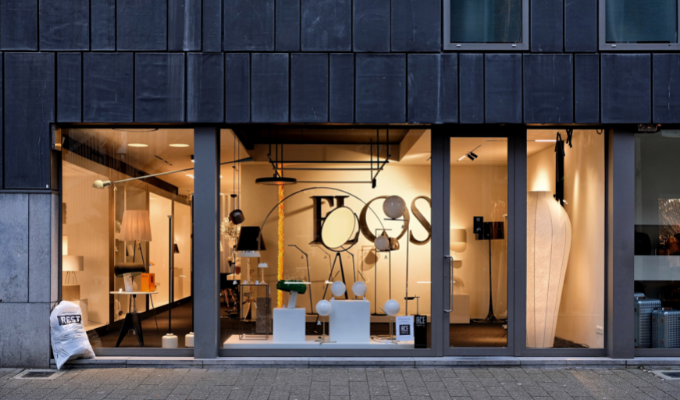
Shop window displays have never been so vital for long-range visibility and drawing customers into stores. With internet shopping and the oft-reported death of the high street, it’s essential to entice new customers over the threshold while encouraging previous customers to return. An attractive shop window design is key to achieving those goals so we’ve put together some pointers to help you get it right first time.

Shop Window Design: The Essentials

The first things to consider for a shop window design are its objectives and the message you want to convey. 

Are you trying to attract attention generally or to draw people to a specific event, such as a sale or new product launch? With that in mind, consider what could draw attention. What would stand out on your street? 

For a sale consider using banners, bunting or self-adhesive window stickers to quickly update your windows. Use colours that passersby will associate with a sale, such as eye-catching red lettering or price tag detailing to reinforce the message. For a new product, consider making it the hero item at the centre of your window

Above all, remember that your message must be cohesive. Tell people what you want them to know and keep it on brand. The concept should include brand colours, typography and messaging so that it’s consistent with your in-store experience.

Spatial Awareness

Planning the space available is essential to the success of your display. You don’t have to put everything in the window just because you have a large space!

Window displays that are busy and interesting can be good, but it’s important to avoid clutter because the eye won’t be drawn to any particular element. Experiment with minimalist designs that highlight a few key pieces, props and printed materials. This can look both attractive and be attention-grabbing. 

Alternatively, consider implementing a theme, colour palette or category (kitchenware, books or clothes) to keep everything cohesive and inspire your customers. 

Don’t just think of the width of the space either; work with the depth, too. Posters or printed fabric or logos don’t have to go at the back but can stick on windows or plinths, or even be suspended mid-display to create a layered scene. 

The same goes for height. The use of lighting, suspension and different display products can be really effective. Just remember that any key products should be the focal point of the window display – ideally at eye level.

Don’t forget that shop windows make great canvases, too. Printed vinyl and decals can be used to form themed borders and incorporate logos or branding. They can even be part of the narrative with stickers of graphics, animals or landscapes to set the scene.  

Seasonal Window Displays

Retailers of any size can really go to town for seasonal events such as Easter, Christmas and Halloween. They don’t call it window dressing for nothing! 

Small or indie shops can use bespoke design solutions and decorations to engage the public and steer their attention to their own products. 

Larger outlets, on the other hand, can be more conceptual and tell a story with their window displays. Think Hamleys, Liberty or Fortnum & Mason. Using a selection of the varied products sold within the store and carefully chosen props and printed material or signs, you can design a one-off and quirky shop window that tells a story. Displays can be targeted, themed and stop potential customers in their tracks.


Types Of Window Display

There are several common types of window display to consider, including:

Open-Backed Shop Window Displays

These have become popular in recent years. The window is fronted by the usual glass but there’s no solid wall at the back of the display. This allows passersby to see through the shop window design and right into the shop, giving a modern and inclusive feel.

Open-backed shop window

Closed-Back Shop Window Displays

These are fully shut off with a wall or screen at the back of the display. They can be useful where the window is in front of an unattractive space or when a backdrop is required.

closed back shop window display

Semi-Closed Shop Window Displays

These, obviously sit between the two above, giving passing traffic a glimpse inside the store, enticing them to enter and find out more. 

semi closed shop window display

Elevated Window Displays

With these displays, items are positioned above ground level. They can be open, semi-closed or fully closed. Different elevations can help you play with the space and incorporate eye-catching elements.

Of course, you can combine open-backed with elevated, or even opt for semi-closed back. 

Elevated shop window display

Shop Window Display Materials

Well-placed props and furniture can really make for a great shop window and drive footfall. Many generic items can be sourced online but we can produce bespoke items for your brand!

Not sure where to start? Here are few suggestions:

  • Mannequins: Display clothing, accessories and create a tableau
  • Window decals: Printed text, graphics or QR codes that can be attached to the windows
  • Posters and artwork: Draw the eye, share a message or inspire viewers
  • Furniture: Display stands, shelving, platforms and plinths allow you to showcase key items
  • Tech: TVs, screens and neon signs can be used to add movement
  • Banners, bunting and signs: Make use of the space and add a splash of colour
  • Lighting: Add to the atmosphere and enhance the display after dark
  • Printed fabric: Add texture, colour and designs to your display
  • 3D-printed giant props: Use 3D printing to create giant products and eye-catching items

Shop Window Sustainability

There are no hard and fast rules about how often to change shop window designs. It can depend on the time of year, the size of the shop or budget you have available. It could be every few weeks, twice a year or seasonally. It really depends on your needs or objectives.

In fact, signs with writing or imagery, say for Christmas, Easter or Halloween, can be reused, repurposed or recycled every year or every few years. Just ensure they’re stored somewhere safe and dry.

And remember, we can also source sustainable and recyclable materials to produce your window displays, so you can be sure your displays have minimal impact on the environment.

Get in touch

Not only can our graphic designers help you to create show-stopping shop windows, but we can manufacture bespoke items and deliver to your door. To find out more about our expertise and experience, give us a call on 01603 620780.

View this original article and other news from BDH Tulford here

About Us

The Importance of Workplace Wellness

Laryd

In this article, we explore the concept of workplace wellness, the benefits for business and some of the practical steps you can take to support your team’s wellbeing.

Before we delve into why workplace wellness is important, we should start by explaining what it is. A good place to start is the International Labour Organization definition. It says:

“Workplace Wellbeing relates to all aspects of working life, from the quality and safety of the physical environment, to how workers feel about their work, their working environment, the climate at work and work organization.”

Put simply, ‘workplace wellness’ refers to the impact that a place of work has on individuals’ mental and physical health.

In recent years you may have noticed growing interest in the topic from both businesses and their employees. Why? Because there are big benefits for both parties. In fact, according to the Health & Safety Executive (HSE), 28.2m working days were lost in 2018/19 due to work-related illness; 12.8m of these were due to stress, depression and anxiety. That’s a lot of lost time for a business of any size.

Workplace wellness has also been linked to increased productivity, employee loyalty and retention rates. And given that it costs an average of £3,000 to hire someone in the UK, it’s clearly in a business’s interests to support their employees’ wellbeing.

And the benefits of workplace wellness for employees is clear too: individuals are healthier, happier and more inclined to enjoy their jobs.

So if you’re convinced of the benefits, what are the key steps you can take to improve wellbeing in your workplace?

Health initiatives

Encourage your employees to engage in healthy activities. From on-site yoga and fitness sessions, to giving away free fruit and healthy snacks, businesses can support healthy behaviours.

In fact, the benefits of exercise go beyond the physical. The endorphins and hormones released during exercise can help with mental health. Plus, team activities help employees to bond and feel like they belong.

And while open-plan offices get a bad rep, there are actually health benefits. Recent research published in the British Medical Journal shows that employees in open-plan offices are 31.8% more active than those in cubicles and private offices.

Ergonomic Environments

While it should come as no surprise, it’s worth a mention: furniture has a big impact on health and wellbeing.

The HSE states that 2.8m working days were lost due to back disorders in 2018/19. This could be eased or avoided by providing the right equipment, such as desks and workstations set at the correct height.

If your employees work remotely, consider investing in equipment for home working, reducing their risk of injury.

Biophilic Design

Biophilic design is a big trend right now, and for good reason. Biophilic design incorporates elements of the natural world into interior spaces to promote wellbeing.

From increasing the number of natural surfaces to promoting natural light and airflow, there are multiple different aspects to the trend. Want to incorporate biophilic elements in your workplace? Research shows that the presence of plants in a building can increase feelings of wellbeing by as much as 40%.

Flexible & Agile Working

While similar, these two practices are slightly different. Flexible working allows employees to shift their working hours and places of work to fit in with their lives, while agile working is more focused on the most efficient means of completing a task, which may include flexible working.

Either way, it can have significant benefits for individuals and businesses. Multiple studies demonstrate that increases job satisfaction and results in greater productivity.

Coronavirus Considerations

Of course, it would be remiss of us to not mention the ongoing coronavirus pandemic.

The virus has prompted businesses around the world to focus on workplace wellbeing like never before. Employers have made widespread changes to working practices to ensure the health and safety of their teams.

As a result, even the most traditional of businesses have introduced flexible and remote working. Office layouts have changed to introduce social distancing measures, while outdoor meetings have resulted in increased exposure to nature.

And it’s not likely to stop there. The impact of the pandemic will continue to affect our understanding of workplace wellbeing long into the future. We, like you, will have our eyes focused on the new trends as they develop.

Find out more

At Layrd Design, we’re committed to workplace wellness. Founder William Mayes is training to become a qualified WELL practitioner, formalising his skills and experience in this area, creating healthy, productive workplaces that encourage employees and businesses to thrive. If you’d like to promote workplace wellbeing in your business, get in touch.

Disclaimer:

Thank you for visiting our bog! This blog is a resource guide for inspirational and informational purposes. All the information found on my blog should be used at your own risk. All photos that are not taken by Layrd Design are linked to their sources and are widely available to download on the internet by the general public.

All the written content is copyrighted, copying of our written texts are prohibited.

You can view this original article here

Norfolk County Council commissioned Community Catalysts are delighted work in partnership with House Angels Decluttering Specialist

Community Catalysts

Norfolk County Council commissioned Community Catalysts are delighted work in partnership with House Angels Decluttering Specialist

House Angels provide hands on, highly practical support for Norfolk people who are struggling with clutter or disorganisation around their homes. Many of their clients have had falls due to clutter becoming a trip hazard or other issues relating to their physical or mental health. 

House Angels can make living conditions safer, improve the quality of people’s lives, enable a cleaning team to go in, prevent a person from being evicted from their home or clear space for maintenance work to be carried out. They aim to look beyond the clutter to the person behind to find out more about them and understand the changes that are needed.

The idea for House Angels was formed out of experiences within their own family. Initially intended as a service to help people who were living in cluttered and disorganised conditions, as their father had been before he was admitted to hospital. As the idea evolved, they also thought about how their grandmother’s house had needed reorganisation and adaptions before she could return from hospital because her mobility had deteriorated. They had support around them to help make the changes that were needed but knew not everyone was so lucky. 

They enrolled on a business start-up course and gradually House Angels was born; finally launching in 2019. There were mistakes along the way and it’s been hard work, especially during the pandemic when they couldn’t see a way through. But, as is often said, they learned as much from mistakes as success! The pandemic has definitely taught them to be flexible, have confidence in what they do and not to give up.

A real positive for them has been joining the Community Catalysts project in Norfolk. It opened up many doors, put them in touch with social care and other small enterprises in the area and helped them to focus on where they want the business to go and adapt the services that they offer today. 

It’s been a long journey but they now feel they have a business that they can be really proud of and they’re getting lovely feedback from their clients and their families. One client’s reaction really summed this up. They had completed a 3 hour declutter and clean-up of his kitchen and bathroom. When he came to inspect their handiwork, he welled up and said “You have made me feel human again”. Another client, that they had worked with over many weeks, decluttering and clearing his late mother’s possessions commented “Every visit brings light into the house, lifting my spirits too!” Decluttering may seem to some like a luxury service but for House Angels client’s it can be life changing. They give their clients back a tidy house but also a home they can enjoy living in again.

https://www.facebook.com/House-Angels-Decluttering-Specialist-586974898463500

For more information about the Community Catalysts project in Norwich please contact Debra Morris

☎ 07384 835722 ????debra.morris@communitycatalysts.co.uk

30 under 30 – Jamie Minors Managing Director of Minors & Brady

Norfolk and Waveney’s 30 under 30 Jamie Minors discusses Minor & Brady’s journey.

Why and how did you set up your business?

I worked as an estate agent, managing branches for another firm, and I felt there was a better way to provide the best customer service to people who wanted to move homes. As I didn’t have the full power to make all the changes I felt necessary, I saw setting up was the only way possible to create the new face of estate agency in Norfolk and Suffolk. I re-mortgaged my house to raise funds, found a premises that suited, did a lot of cash flow forecast predictions and rolled the dice! Luckily it’s worked out well hey. I joined forces with Alex Brady around 7 months after I set up, as I needed some help to push things the way I wanted to, and he was also looking to go alone. I wanted to create something personable, with value, that did things properly, but also made profit!

 What makes your business unique?

As above, we provide people with a personal moving experience. We hire real people, with real personalities who care about a client’s move. Our team are what sets us apart, as we have weekly training for staff, lots of work events/dos, team togetherness excercises and fantastic promotion opportunities from within. We promoted 7 people internally last year, showing our commitment to our people. They in turn, provide their commitment to a seller or buyer, which makes our service so fantastic. We have over a thousand 5 star google reviews, and our Wroxham office is one of the most reviewed estate agency branches on Google in the whole country!

What are your business goals for the future?

Our visions are to expand, but only once we find the right people. We currently have 5 branches, but we aim to push to 10 within the next few years. We will only go to areas we know, we have a love for and where we feel we can genuinely add a great service to buyers and sellers locally. Longer term, we have no intention to ever sell, and we’d love to bring people through our business to become partners within. This is our ethos, look after our own and they will look after us.

https://www.minorsandbrady.co.uk/

24 fingers crossed, you’ll soon be able to post to Instagram from your desktop

24 Fingers

Instagram has always had a mobile-first approach. Which is great, if you’re out and about and using the app as it was originally intended, to post insta(nt) photos of what you’re up to. But let’s face it, it’s no longer 2010, and in the last ten years or more, many of us are now seeing the benefits of using Instagram for our businesses. As such, wouldn’t it be really, really handy to occasionally be able to post to your Instagram feed from your desktop? Well, we’re here to tell you that with a click of one of our 24 fingers, it’s no longer a pipe dream.

Instagram plans to allow for desktop posting

Although there are lots of features that can be used on Instagram from your desktop, annoyingly, the most important aspect of the platform – posting photos to your Instagram grid – isn’t one of them. Rumour has it though, that Instagram is currently planning to allow users to create posts from their desktop. There are reports that Instagram is working on including a button to post photos directly from your desktop to your Instagram feed.

Initial ideas and images suggest that users will then have the opportunity to edit the image, as you do on the mobile app. This includes choosing the aspect ratio of your image and picking filters, as well as the expected options to add a caption, tag people and add your location information.

Our 24 fingers will be poised to give Instagram a massive high five if this functionality is rolled out to desktop users: it’s been sorely missed by many a business owner who prefers creating social media content from the desktop, for example if your images are stored on an online server or if you’re simply more efficient on desktop than mobile. So let’s keep our collective fingers crossed that Instagram give it the green light.

 And until then, how can you post to Instagram from your desktop?

Although it will be fab if Instagram roll out the ability to post from your desktop, this all very much appears to be in the initial stages at the moment – if it happens at all. So until then, what can the desktop lover do to make Instagram work for them?

Well, there are ways and means around it. And our 24 fingers are tapping away at the computer keyboard constantly, making them work for our clients, and regularly posting from the desktop. We may even have our ways and means of posting to your stories from the desktop, too.

Want to know more about how you can post to Instagram from your desktop? Get in touch and you’ll be just a few short clicks away from posting to Instagram directly from your desktop.

LinkedIn’s new features promise to make business owners’ lives a little bit easier

24 Fingers

We know many business owners wear several hats, from HR to PR and back again and there are some days that really ought to be four times as long, so everything gets done. Fear not, under-pressure damsels in business distress. Like a knight in slimline silver armour, Linkedin’s new features are coming to your rescue and promise will make life a bit easier. 

We’re big believers in every little helping, so let’s take a closer look at the goodies (Ed’s note: don’t you mean the Goode stuff? #badumtush)

Supercharge your posts

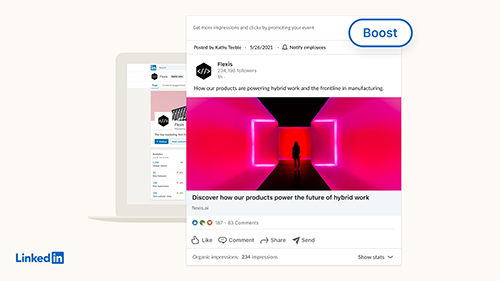
Linkedin Boost post

Taking a shameless leaf straight out of Facebook’s um… book, Linkedin will now allow you to boost a high-performing post to really supercharge your social media post’s engagement. 

It might sound like a cue for a song, but Linkedin says all you need are a “click of a button and a few payment details”, it’s a quick and effective way to expand a post’s reach without having to learn any new marketing tools. Nice. 

Amplify event promotion and measure the results

Linkedin event promotion

If the past year or so has taught us anything, it’s that many of us are more comfortable in front of the camera and crowds than ever before. 

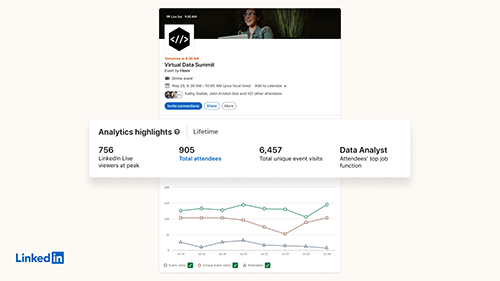
If you’re among the businesses using group and community meetings or events as part of your marketing strategy, Linkedin’s Event Ad feature will help promote your event to a new audience, highlighting key details such as date, time, and how to join. 

It will also let members know if a mutual connection will be attending, so watch out for talking at the back. 

That’s smart enough on its own, but Linkedin’s new features also include an Event Analytics tool that offers insights into the reach, engagement, and companies behind event attendees, crucial information for tailoring or targeting future events. 

LinkedIn Live gets a boost

Linkedin Live

Business owners looking to get in on the livestreaming trend went crazy for Linkedin’s Live feature, which saw a more-than 400% YoY increase in the past 12 months or so. 

The chaps at the business platform have taken note and unveiled Custom Streaming, a nifty feature that allows members to use the broadcast tools they are most comfortable with, whether that’s Zoom, WebEx or OBS. If Microsoft Teams is your bag, that’s on its way too. 

Measure performance on the Go

Linkedin Mobile

Linkedin has finally realised many business owners aren’t chained to their computers 24/7 and can get out and about from time to time. 

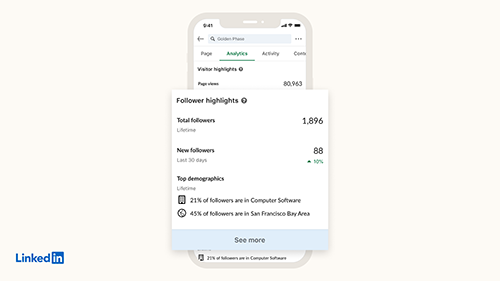
With that in mind, they’ve launched Mobile Page Analytics, sending all the visitor, follower and content insights, including organic and boosted metrics, normally accessible on your desktop, straight to your phone. 

If you’re still struggling to get to grips with Linkedin’s new features, give us a shout and we’ll soon have you LinkedIn-ing like a pro.  

We’re 24 fingers, a digital marketing agency and a proud member of the 42 Club, Brentwood Chamber of Commerce, Excel Business Networking Group, the Trusted Business Community, the Organisation for Responsible Businesses and the Rotary Club of Brentwood à Becket. We help companies who are all fingers and thumbs with their social media grow their business and brand. Book your free strategy call here.

Why collaboration might be the cornerstone of success for academy trusts

Price Bailey

One thing that you cannot deny throughout the COVID-19 pandemic is the Government’s sustained efforts to try and support businesses and scaffold the economy in a time of significant uncertainty. As the country moves toward a normality that resembles life pre-pandemic, many businesses are asking what support is available for those still feeling the impact and for those who are wishing to maximise on opportunities available to them.  

In March, the Government announced the closure of the Bounce Back and Coronavirus Business Interruption Loan schemes; and introduced the Recovery Loan Scheme to provide continued financial support to businesses across the UK as they trade out of the pandemic. 

The scheme is open to any business that has been affected by COVID-19, and the use of funding is unlimited, provided it is for a legitimate business purpose. Businesses can borrow up to £10m per business (or up to £30m for groups). Businesses will also be happy to hear that you can still access this scheme, even if you have accessed other Government support schemes such as the Bounce Back scheme, CBILS or CLBILS. However, the amount available to borrow under the RLS will be reduced by any borrowing from previous schemes. 

The scheme provides guarantees to lenders via several different facility types:

  • Term loan
  • Overdraft
  • Invoice finance
  • Asset finance

It is important to note that not all lenders are accredited to offer all types of facility. 

Businesses seeking to apply for the scheme should ensure they have sufficient debt capacity to take on any additional funding of this kind. In addition, we strongly advise that you (with support from your advisors, if required) take the time to appropriately plan and produce a robust cash flow forecast to ensure that:

  1. there is a legitimate requirement for the funding
  2. you know to what level funding support is required
  3. that the business is in a position to service the debt

This is relevant for any business considering the scheme, but particularly to those businesses that have already accessed other Government support schemes (or other commercial debt facilities) and are yet to understand the true amount of their repayment commitment fully; and/or whose turnover/working capital continues to be impacted by the pandemic and is variable upon the success of the easing of social distancing restrictions. This is also particularly relevant as, as with other external finance applications, you will need to be able to provide a solid business case for the funding, proving you will be able to meet the repayment obligations.

So how does RLS work? 

The RLS will be available through named lenders accredited by the British Business Bank. Further accredited lenders may be added as the scheme continues, and you can view the current list on the BBB’s website. However, lenders are advising that you speak with your existing finance provider first before approaching these lenders, as they may be able to offer you a commercial loan on better terms. 

Key features of the scheme:

  • The scheme will remain open until at least 31 December 2021, subject to review.
  • There is also no maximum cap set for the amount available to lend to businesses through the scheme – so there is no need to rush to apply if you do not feel you require financial support in the immediate term.
  • There is no minimum or maximum turnover restriction for businesses seeking to access the scheme.
  • The upper limit of the facility provided to each business is £10m (and up to £30m across a group), with minimum facilities starting at £1,000 for asset and invoice finance, and £25,001 for term loans and overdrafts. (Please note – individual lenders will set their own minimum and maximum limits within these ranges).
  • The scheme gives the lender a government-backed guarantee against the outstanding balance of the facility.  
  • The annual rate of interest, upfront fee and other fees cannot exceed 14.99%, and businesses are required to meet all costs, interest payments and fees associated with the facility. 

Term lengths:

  • Term loans and asset finance = 3 months – 6 years
  • Overdrafts and invoice finance = 3 months – 3 years
  • If you borrow £250,000 or less, personal guarantees will not be taken by the lender. For borrowings over £250,000, personal guarantees are at the lender’s discretion. Still, the maximum that can be covered is 20% of the outstanding balance of the RLS facilities after the proceeds of business assets have been applied.
  • Lenders can offer an RLS facility to those businesses that would either not gain the funding on standard terms or would do but at a higher rate without the benefit of the government-backed guarantee.  
  • In contrast to other Government support schemes, the RLS will not include 12-month Business Interruption Payments (BIP) to cover interest payments. 

Our advice to those looking to access the scheme:

While this next stage of Government support for businesses is being welcomed, business owners should remember that it is still a loan that needs to be repaid. Its purpose is to support with working capital requirements or to support growth. Lenders will be looking for you to be confident in and provide suitable evidence to support that the funding will be used to help the business grow, further benefiting the economy with jobs and supply chain benefits.

It is also worth remembering that there is no cap on the funding available to all businesses. The scheme remains open to applications until 31 December 2021; therefore, there is no immediate need or panic to apply for funding. Instead, it is better to take this time to develop your business’ recovery plan properly, revisit your strategy, and put together a robust set of financials to identify what, if any, funding requirements you have. This may start with improving working capital efficiencies, cutting further none essential spending and equity or other debt funding options (aside from RLS). This will mean that not only will you potentially avoid taking on further debt unnecessarily, but also, if applying for RLS is the right thing for your business’ recovery, you will be adequately prepared for lenders’ due diligence. 

 We always recommend that you seek advice from a suitably qualified adviser before taking any action. The information in this article only serves as a guide, and no responsibility for loss occasioned by any person acting or refraining from action as a result of this material can be accepted by the authors or the firm.

You can view this original Price Bailey article here

 Subscribe

For more insight, events and webinars, sign up to the Price Bailey mailing list…

Sign up