Global Village is a one-of-a-kind, multi-cultural festival park that operates seasonally, showcasing different cultures from around the world, in a lively, outdoor atmosphere. Global Village is renowned for it’s shopping experience showcasing authentic products from around the world. Total transactions at Global Village exceeded € 590 million (AED 2.3 billion) last season. This will be Global Villages 22nd Season and is proud to have attracted 5.6 million visitors last season and been voted the No 1 Leisure attraction in the Middle East (You Gov). Our Vision is to be one of the top ten international brands for family entertainment and cultural experiences by 2020.
We are looking for new and exciting product s and retailers to fill our European Pavilion
We believe the following products sell extremely well:
HANDICRAFTS
WELLNESS PRODUCTS
FOOD & BEVERAGE
FASHION
GIFTS
ACCESSORIES
But open to all products especially in new in the market. Global Village is excited about working with European Exhibitors and looks forward to them showcasing and retailing unique and authentic products during the next season. Global Village will work closely with exhibitors on all logistic elements from shipping, storage, to accommodation and visa’s to ensure an easy process for our exhibitors.
The Flat Rate VAT Scheme (FRS) was set up by HMRC as a means to simplify and reduce the costs of compliance for small businesses. This meant that such businesses could apply a fixed percentage dependent upon the specific trade or profession they were involved in.
Under the FRS the business would charge full VAT rates to their clients when invoicing and therefore receive VAT at 20%. The business would then only pay the fixed percentage to HMRC i.e. if they fell within management consultancy they would pay only 14% of their invoiced value to HMRC.
The scheme does not permit recovery of input VAT other than in specific circumstances normally in relation to purchases of capital equipment with a value of more than £2,000.
Legislation
HMRC issued draft legislation in early December 2016 which introduced a new rate of 16.5% for ‘Limited Cost Traders’ (LCT) to take affect from 1st April 2017. A LCT is one whose VAT inclusive expenditure on goods is either:-
less than 2% of their VAT inclusive turnover in a prescribed accounting period
greater than 2% of their VAT inclusive turnover but less than £1,000 per annum if the prescribed accounting period is one year (if it is not one year, the figure is the relevant proportion of £1,000
Goods, for the purpose of LCT, must be used exclusively for the purposes of the business but exclude the following items:-
capital expenditure
food or drink for consumption by the FRS business or its employees
vehicles, vehicle parts and fuel (except where the business is one that carries out transport services -eg. a taxi business, and uses its own or a leased vehicle to carry out these services).
An additional downside to this test is that if you have goods that are used part for business and part private use should be totally excluded and not apportioned between business and private.
April onwards
From 1st April 2017 a LCT will have a choice to either remain as part of FRS and pay VAT to HMRC based on 16.5% or to be part of standard treatment VAT i.e. pay net VAT to HMRC having taken into account VAT on outputs at 20% and recover VAT on inputs where charged.
Under the anti-forestalling provisions HMRC have restricted any possibility of a LCT continuing to use any lower FRS rates from 1st April 2017 therefore action if not already taken should be taken now to avoid potential penalties.
If you are still within the first 12 months of VAT registration you will be able to continue with the 1% first year discount so would pay only 15.5% for the remainder of the 12 month period.
If under the legislation you are a LCT then you need to go through the numbers and consider which is the best direction for you. The potential impact on a small business may not be significant and the additional costs involved in fully accounting for VAT under the standard rate may well be more than the VAT involved especially as you will need to provide evidence of any expenditure on which you make a reclaim.
All such businesses will have their own unique situation and we would recommend you speak with your accountant or call the VAT advice line should you need help making a decision.
Two meetings to be held in London in May will focus on the trade opportunities offered by countries in Africa.
Organised by the Business Council for Africa and British Expertise International, the meetings will bring together British diplomats stationed in both East and West Africa.
Both meetings will take place on 10 May. In the morning, a panel discussion at the Business Council for Africa (Lavington Street, London) will feature three Heads of Mission from East Africa: Susanna Moorehead, Nic Hailey and Sarah Cooke.
Susanna Moorehead, British Ambassador to Ethiopia and Djibouti, is the Permanent Representative to the African Union and UN Economic Commission for Africa. She has also served as the Director for Southern and West Africa at the Department for International Development (DFID).
Nic Hailey has been British High Commissioner to Kenya since December 2015. Prior to taking up his current position, he was Director for Africa at the Foreign & Commonwealth Office (FCO), where he had responsibility for all UK policy towards, and operations in, 48 countries across Africa.
The High Commissioner to Tanzania, Sarah Cooke, was previously representative for DFID in Bangladesh.
Starting at 17.00 on 10 May, the second meeting will be held at the premises of Addleshaw Goddard (Chiswell Street, London) and will include five Heads of Mission from West Africa.
Among them will be the UK’s current High Commissioner to Cameroon, Brian Olley, who has previously served in Cyprus, Afghanistan and Finland.
George Hodgson, Ambassador to Senegal and non-resident Ambassador to Cabo Verde and Guinea-Bissau, will also participate in the panel discussion, as will the High Commissioner to Ghana, Jon Benjamin.
In addition to the panel discussions, both events will also provide opportunities for networking. Further information can be found at www.britishexpertise.org.
Heathrow Airport has confirmed that China Southern Airlines will be operating a second daily departure between the UK hub and the Chinese port of Guangzhou with effect from 1 June this year.
It said that the airline’s twice-daily service, the only direct connection between the UK and the southern Chinese city, is strategically important for “a global, outward-looking Britain”.
Using a Boeing 787 Dreamliner, the new service will lower transfer times to China Southern Airlines’ network of over 120 destinations in China, Japan and Korea, southeast Asia, Australia and New Zealand.
Located just 75 miles up the Pearl River bay from Hong Kong, Guangzhou is described as one of China’s most vibrant business markets as well as being its biggest port.
The addition of the new daily service will boost trade capacity to this booming city, by doubling the space for British exports to up to 8760 metric tonnes a year, Heathrow Chief Executive John Holland-Kaye said.
Welcoming the addition of the second service, he highlighted the benefits of increased connectivity to Guangzhou for Heathrow passengers and for British business generally.
“Direct connections to thriving markets like these are essential to keeping our country a global, outward looking, trading nation,” Mr Holland-Kaye concluded.
In 2016, more than 1.1 million passengers used Heathrow to fly to and from Chinese destinations, an increase of 7.3% over the previous year.
Drivers are warned to expect delays on the A1151 Wroxham Road, with temporary signals at the site of the new Green Lane West junction tomorrow (Thurs) and Friday, and a longer stretch under 24-hour traffic lights from Tuesday (2 May).
Tomorrow (27 April) and Friday the traffic lights will be in use after the morning peak, and will be removed as early as possible in the evening. The road will be clear of signals through the bank holiday weekend.
From Tuesday (2 May) for up to two weeks, a long stretch of the A1151 close to the main NDR construction site will be reduced to one lane controlled by traffic lights. This is to allow Anglian Water to complete the diversion of a water main. The active work sites will be at either end of the coned-off carriageway, but too close to run two sets of temporary lights efficiently.
Salhouse Road closure
Temporary traffic lights will remain in use on Salhouse Road at the NDR roundabout construction site until the road is closed for up to two weeks from Monday 8 May to allow completion of the roundabout and tie-in to the existing carriageway.
Reepham Road closure
The current closure of Reepham Road during construction of the roundabout with Drayton Lane is scheduled to continue until Friday 5 May, when Drayton Lane between Reepham Road and Hall Lane (Drayton) will also be reopened. This will reduce pressure on Hall Lane and School Road, Drayton, which are being used as unofficial diversion routes.
Buxton Road closure – new dates
The closure of Buxton Road, Spixworth, originally scheduled for May, has been put back until Monday 5 June and reduced from three to two weeks. This is for the completion and tie-in of the bridge over the NDR. Pedestrian and cycle access will be maintained.
Norwich-based Legal Technology specialists Tiger Eye are finding new ways to raise vital funds for the local community. The IT firm, based at The Henderson Business Centre, offered staff a chance to win an extra day’s holiday by purchasing tickets for a charity raffle draw. To add to the raffle’s appeal, the holiday up for grabs was the 21st of June (the Summer Solstice) which is the longest day of the year. The raffle raised over £100, with all proceeds donated to Norfolk and Waveney Mind, Tiger Eye’s charity of the year.
Alex Wilson, a Technical Analyst from Tiger Eye’s Project Delivery Team, won the raffle and plans to spend the day off in Norwich. Alex added: “I plan to spend my extra day of holiday with an old colleague and Liam from my team. We’ll be shunning the lovely sunshine by attempting to escape a virtual reality escape room, eating burgers or sushi, and venturing to Retro Replay arcade in Castle Quarter.”
This unique fundraising event features as part of Tiger Eye’s overall fundraising scheme for the year, with other events including tea and scones for the Jubilee and various other office activities. In January, Tiger Eye were pleased to announce Norfolk and Waveney Mind as their charity of the year for 2022 following a company-wide selection process.
Julie Wilson, Admin Services Director at Tiger Eye, added: “It has been a pleasure to find new and unique ways to fundraise for Norfolk and Waveney Mind, and we are delighted to make an impact in our community. As a business, we aim to create an environment where staff feel able to talk openly about mental health, and we highly value the crucial work of Norfolk and Waveney Mind in our area.”
Norfolk and Waveney Mind support those within the community with their mental health and wellbeing from prevention support to crisis support. The charity offers an extensive range of mental health services, along with associated training, advice, and information, working to reduce the stigma associated with mental health, support people in recovery, and champion better services for all. Whilst part of the Mind network, Norfolk and Waveney Mind are an independent charity who raise their own funds.
A bespoke prototype designed by King’s Lynn based Southgate Global, a leader in the supply of packaging equipment, consumables and servicing in operational logistics and fulfilment, has helped a leading retail brand reduce their loading time by 50 per cent.
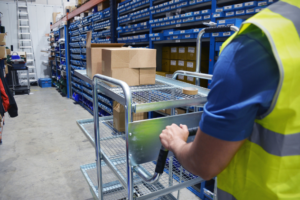
Working closely with the online grocery brand – who were experiencing too many touchpoints, as well as some manual handling safety issues, around transferring groceries from their warehouse operation into their vehicles, Southgate’s expert in-house Design Team designed a bespoke cart specifically to address these issues, working for the specifics of the client’s site, their space requirements and the people using it.
With each minor detail designed with a specific workflow in mind, the three-tier cart enabled the client to save 50 per cent in their loading time, increasing productivity for the business.
As the need to maximise productivity in all areas of an operation has never been so crucial, Phil O’Driscoll, Head of Innovation and New Product Development at Southgate Global, explained that customised products that meet very specific needs or address unique challenges are becoming more in demand.
“Customers either recognise an issue within their workflow but are unsure on how to fix it themselves, recognise that the standard equipment they are currently using just isn’t working to maximum potential, or they are being faced with new challenges that existing options cannot resolve.”
“It’s here that the benefits of bespoke solutions come into play, and our garment trolley is a prime example of this. Right from the initial survey to the design brief, prototyping and final implementation, we built a solution that was based on expertise and experience and with a specific goal in mind. A service you just can’t get with off-the-shelf solutions.”
With decades of experience serving over 3,000 customers in more than 20 countries around the world, Southgate prides itself on its expertise and range of operational logistics and fulfilment solutions that support some of the biggest organisations in the key sectors including 3PL, e-commerce, retail, post & parcel and general manufacturing.
Describing the Southgate Design Team as ‘problem solvers’, O’Driscoll explained the intricate process of each bespoke solution.
“We start each project from scratch with no assumptions or preconceptions. The team apply themselves to deeply understand the problem, ensuring to ask the right questions. Once we have the concept, we created a prototype before designing a final solution that meets the client’s exact needs.
“Whether we’re fitting equipment to existing architecture or helping to redesign the process of how they move products from A to B, it’s a form of flexibility and personalised service that you just can’t find from off-the-shelf solutions. This approach means the solution is something that organisations can use as a key differentiator to make them more competitive. In an increasingly challenging environment where price is often used as the only point of differentiation this approach can make all the difference.’
Innovators across 3PL are using bespoke design solutions to improve efficiencies to improve any manual handling.
As the challenges of running an efficient and cost-effective fulfilment operation continue to grow, Southgate continues to invest in creating innovative material handling equipment to help deliver a productive warehouse operation.
For more information on Southgate’s design services, click here.
The British Chambers of Commerce (BCC) has today (Tuesday) launched ‘Brexit and Beyond’, the Chamber Network manifesto for General Election 2017.
The Chamber manifesto calls for the new government, which will be responsible for negotiating the terms of the UK’s departure from the European Union, to provide business communities with clear answers to the pragmatic and practical questions around how Brexit will affect their day-to-day operations, including hiring, customs procedures and regulation.
However, business communities across the UK, including Norfolk, send a very strong message that the election cannot – and must not – be about Brexit alone.
The next government must deliver a bold and clear strategy to support economic growth across all regions and nations of the UK. Action is needed on a range of domestic fronts, including improving the competitiveness of the UK’s business environment, upgrading physical and digital infrastructure across the country, and supporting local growth.
The Norfolk Chamber business community will judge the next government against five key criteria:
Infrastructure – revolutionise Norfolk’s physical and digital infrastructure. Ensure that the whole of Norfolk has access to super-fast broadband, better mobile connectivity, and delivering investments in the strategic schemes such as the A47 improvements, the Western Link of the NDR and the Great Yarmouth Third River Crossing, all of which will unlock the economic potential of the region.
Business Environment – deliver a globally competitive business environment. Ensure the best business environment possible with a relentless drive to improve the skills set of tomorrow’s workforce, without clobbering firms with ever-higher upfront costs.
Local Growth – unlock the potential of the local business community and maintain the place-based focus of the Industrial Strategy to ensure Norfolk’s key sectors can thrive and grow.
Trade – support Norfolk exporters to drive economic growth. Expand trade support programmes, secure continued access to existing Free Trade Agreements, develop trade policy with business, and leverage Chambers of Commerce, which are best placed to provide stable export support in all regions of the UK.
Brexit – work with businesses to secure the best possible deal with the EU. Protect the status of EU nationals in the UK, develop future customs procedures in partnership with business, create a future UK immigration system that is responsive to economic needs and skills shortages at all levels, and ensure that there is no hard border between Northern Ireland and the Republic of Ireland.
Jonathan Cage, President of Norfolk Chamber said:
“While businesses all across Norfolk want a good Brexit deal, they are very clear that decisions taken here at home matter as much – if not more – to our future growth prospects. The best possible Brexit deal won’t be worth the paper it’s written on if firms cannot recruit and train the right people, get decent digital connectivity, or get their goods to their market.
“At this election, the Norfolk business community wants a clear commitment from all parties to create the best possible conditions for growth. Westminster must stop and reverse the relentless increases in the up-front cost of doing business in Britain, and give local businesses the confidence to drive investment, job growth and exports through the Brexit transition and beyond.”
Norfolk Chamber’s priorities for the next UK government include:
Deliver frictionless future trade arrangements with the EU, and ensure that business continues to benefit from existing Free Trade Agreements (FTAs).
No new upfront taxes on businesses for the duration of the next Parliament.
Develop a new UK regional funding system with maximum local autonomy, a strong voice for business and focus on economic growth.
Deliver promised investment in road and rail infrastructure, and ensure businesses in Norfolk have access to world-class digital infrastructure.
Dr Adam Marshall, Director General of the British Chambers of Commerce, said:
“The key to a successful Brexit – and future economic growth – is to do everything to unlock the growth potential in our towns, cities and counties. Implementing an Industrial Strategy which harnesses the power of local areas should be a priority for the new government, alongside a commitment to secure the appropriate support and funding for its implementation.”
In October 2016 the Government announced the expansion of Heathrow Airport. An expanded Heathrow will double the airport’s cargo capacity and increase the number of domestic connections, boosting Britain’s exporters and ensuring every region and nation of the UK can get to global markets. With up to 40 more long haul destinations, the project will make Britain the best-connected country in the world.
Heathrow has committed to maximising opportunities for British businesses, including those in Norfolk, of all sizes who could benefit from being involved in the building one of the largest privately-funded infrastructure projects in Europe.
Interested applicants should visit https://procurement.heathrow.com to register their interest and complete an Expression of Interest questionnaire before 31st July 2017. All applications will be considered by Heathrow and a list of potential sites is expected to be announced later this year.
Bookkeeping & Accounts services, Accounts to P & L and Balance Sheet, Vat Returns, PAYE & Payroll Services, Management Accounts and Accounts Analysis Work, Workplace Pension and Auto-Enrolment work
Norfolk Community Foundation has officially launched their ‘Good for Good’ programme, a groundbreaking initiative to make it easier for local businesses to achieve greater social impact.
What is Good for Good?
Good for Good helps Norfolk businesses of all sizes with the charities that need their time, expertise, and resources. Whether it’s offering professional skills, donating assets, or providing funding, Good for Good ensures local businesses’ contributions help those who need it most.
Why did we start it?
Good for Good is brought to you by Norfolk Community Foundation. We wanted to offer a way for businesses to support causes close to their hearts and achieve more by coordinating their efforts. We also wanted to help charities by directing support and energy where it will really make a difference. Connected to over 2,000 voluntary sector organisations and 100 local businesses, we have real-time knowledge of the most pressing needs in our community and the ways businesses can help to meet them.
How do we ensure everyone benefits?
As part of Good for Good, businesses get what they need, and charities do, too. Good for Good offers a framework for businesses to direct resources where they are needed most to create thriving communities, all while helping them to articulate their ESG impact to stakeholders, colleagues, and customers.
What’s new with Good for Good?
Building on the success of Norfolk ProHelp, which paired charities with professional skills, Good for Good offers an enhanced platform. It allows businesses to strategically address the needs of local charities through targeted giving, staff time, and sharing assets. Good for Good makes the process more efficient and impactful, working consciously, systematically and sustainably to serve local community needs.
Join them in making a difference! Together, we can create thriving communities across Norfolk.
Above: The new running in board at Brundall Gardens. Pictured from left: Gillian Lincoln, station adopter, Martin Halliday, Wherry Lines CRP, Greg Chandler, station adopter and Phil Hogg, Greater Anglia’s Asset Management Project Delivery Site Manager.
New signage has been installed at Brundall Gardens Station combining a modern twist with a nod to the past.
Brundall Gardens station on the Wherry Lines between Norwich, Great Yarmouth and Lowestoft has been cared for by adopter and nearby resident, Greg Chandler for almost 20 years and his efforts have seen the station recognised with awards and a special wildlife friendly accreditation.
Over the past few months, the station has received substantial investment by train operator, Greater Anglia, which has included the resurfacing of platforms and a new lighting scheme. The recent works have enabled some changes to the station planting and this has enabled new station name signs known within the rail industry as Running in Boards to be installed.
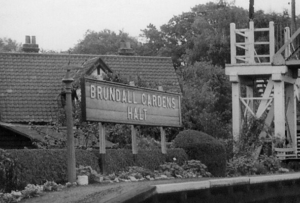
The new signs have been funded by the Wherry Lines Community Rail Partnership and are a modern twist on the original signage in place when the station opened as a halt in the 1920s.
Construction of the signage has been a family affair with Greg building the frames and his son, a cabinet maker, creating the mahogany architrave. Greater Anglia’s project delivery site manager, Phil Hogg who has been overseeing the station improvement scheme assisted with the installation.
Station Adopter Greg Chandler said, “I’ve wanted to reinstate the traditional Running in Boards at the station for several years, having seen them pictured in old photographs. When the project to install new lighting at the station began, it was necessary to remove some of the hedging and this gave the opportunity to create a little more space, enabling the installation of the new signs.
“They are a modern take on the original signage and I am grateful to Phil Hogg at Greater Anglia for his assistance in installing them and to the Wherry Lines Community Rail Partnership for providing the funding.”
Martin Halliday, Community Rail development Officer added; “We were delighted to assist Greg with funding for new signage at Brundall Gardens. Based upon original designs from the 1920s, these splendid additions include a modern element which will make them more friendly for passengers. We are continually looking to improve station signage across the area and where possible incorporating larger signs which are also helpful for those with dementia.”
As part of Greater Anglia’s upgrade of the station, the project team have also installed a specially constructed composting unit donated by principal contractor Braybrook and will be assisting with new planting in the spring.
Phil Hogg, project delivery site manager at Greater Anglia said; “We have worked closely with Greg and Gillian to carefully undertake improvements to the station infrastructure, the work involved removing a substantial amount of hedging, new lighting and re-surfacing and we were pleased to be able to support efforts to install this excellent new signage.”
The railway station opened in 1924, some 80 years after the line first opened, and was initially named Brundall Gardens Halt. The station was jointly funded by the railway and cinema impresario Mr. Frederick Cooper who owned the adjacent Brundall Gardens. It was built to support visitors to the lakes, waterways and a restaurant which were part of the original gardens. Today, around 14,000 people use the station annually, a mixture of residents and those visiting the nearby marina.
The station is adopted by Greg Chandler and Gillian Lincoln and features a fascinating array of planting, supporting bees and butterflies. The recent works at the station has facilitated additional space for new planting schemes which Gillian is currently planning.
The station was the first in the region to receive accreditation for its wildlife friendly environment and Greg and the volunteer team have been recognised at both regional and national level for their efforts.
Above: Brundall Gardens Halt signage circa 1960 (courtesy Graham Kenworthy Collection)